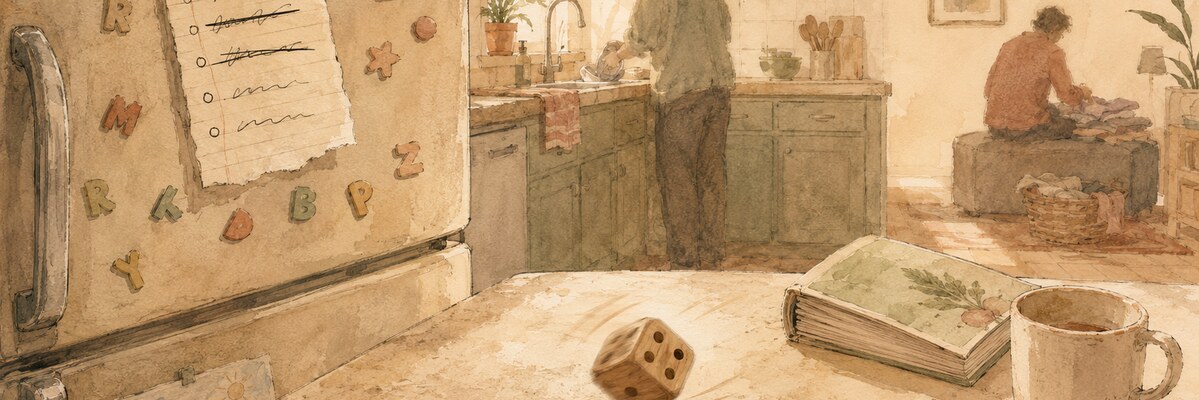
It is nine on a Sunday night. There are two mugs on the counter, a half-eaten bowl of pasta in the sink, and a bin bag that someone has tied but not taken out. One of you is leaning against the fridge. The other is wiping the same square inch of countertop for the third time. And you are about to have, for the forty-seventh time, the conversation about who emptied the bins last.
You both know the moves. There is the opening — light, almost casual, a small observation about the bins. There is the counter-move — also light, also casual, an observation about something the other person didn't do either. There is the slow narrowing of tone. There is the moment where one of you says "I'm not saying you never do anything," which means the conversation has now formally begun. By 9:11 someone is in the bedroom. By 9:30 one of you is back, slightly conciliatory, and the bin bag is still by the door.
This is, statistically, a normal evening. It is also one of the most consistently unresolved fights in modern long-term partnerships. And the reason it doesn't resolve isn't that you're bad at communicating, or that one of you is genuinely the messier person, or that the right division of labor has eluded you. The reason it doesn't resolve is that it isn't actually a fight about chores.
What the Chore Fight Is Really About
Sociologist Arlie Hochschild made the point with unusual durability in her 1989 book The Second Shift, which followed dual-earner couples through the daily reality of who did what around the house. Hochschild's finding — that working women were, on average, performing a roughly twenty-four-hour-per-week additional labor shift at home compared to their working husbands — has shifted in its specifics across the decades since, but the underlying structure has been depressingly stubborn. The visible portion of household labor is only one layer of the actual workload. Underneath it sits a second, mostly invisible layer of planning, anticipating, remembering, scheduling, and noticing — what the more recent literature calls the mental load.
The sociologist Allison Daminger sharpened the picture in a 2019 paper in American Sociological Review, "The Cognitive Dimension of Household Labor," based on interviews with thirty-five dual-earner heterosexual couples. Even in couples that had explicitly tried to split the visible chores down the middle, Daminger found, the cognitive work — anticipating that the school forms would need filling, noticing the milk was almost out, holding the running schedule of birthdays and pediatrician appointments — fell disproportionately on women. The chart on the fridge said equality. The internal mental project-management said something else. Both partners often described the same arrangement as "fair," and were both, in different ways, wrong.
This matters for the kitchen fight because most chore arguments aren't really about the surface item. The bin bag in the doorway is the symbol. The grievance underneath is closer to: I have been carrying a ledger you have not been reading, and tonight is the night it tipped over. When the partner doing more of the mental load erupts about the bins, the other partner often responds, sincerely, with a defense of how much they do — and they are also right. Both partners are tracking real labor. They're just tracking different layers of it. They will not converge by negotiation, because the layers don't translate into each other's terms.
Why It's Perpetual
The clearest framework for what this means long-term comes from John Gottman's research at the University of Washington's Love Lab, which has been running observational studies of couples since 1986. One of Gottman's most stable findings — reported most accessibly in his 1999 bestseller The Seven Principles for Making Marriage Work, co-authored with journalist Nan Silver — is that roughly 69% of conflicts in long-term couples never get solved. They get managed, with varying degrees of skill. The remaining 31% are situational disputes that respond to better communication. The 69% don't, because they aren't communication problems. They're differences of person.
of conflicts in long-term relationships are perpetual — rooted in fundamental differences between the partners that won't go away with better communication. The chore fight is a textbook example.
The chore fight has all of the diagnostic features of a perpetual problem. It started in roughly the first year of cohabitation, even if you didn't have language for it then. The script is familiar to both of you; you could each predict what the other will say next. And the underlying difference — in cleanliness standards, in tolerance for clutter, in how the home is supposed to feel — is tied to temperament and family-of-origin patterns that aren't going to change because one of you wrote a better chore chart on a Sunday afternoon.
The depressing implication is that the bins conversation, treated as a problem to be solved, is unsolvable. The liberating implication is that the same conversation, treated as a perpetual difference to be managed, has a lot of viable management strategies — most of which involve stopping the conversation rather than improving it.
Why "Fair" Negotiations Quietly Fail
The standard response to chore disputes — the one most couples instinctively reach for — is to renegotiate the split. Sit down with a list. Talk through who does what. Agree, in principle, to a fairer distribution. The chart goes on the fridge.
It works for about four weeks. Sometimes six. Then it stops working, and the underlying reason is structural rather than personal.
The first problem is the ledger itself. Both partners enter the negotiation with a private internal record of what they have been doing and what the other one has been failing to do, and these two records cannot be perfectly compared. Each of you has been weighting your own contribution by its mental cost — the planning, the remembering, the worry — while pricing your partner's contribution at its visible labor cost only. You will not match. You can't match. The negotiation is, at its core, two people quietly insisting that their own ledger is the real one. The conversation is exhausting for the same reason that two people arguing about the value of two different currencies, without an exchange rate, is exhausting.
The second problem is the timing. The chore conversation almost always happens at the end of the day, when both partners have spent the day making decisions — work decisions, parenting decisions, money decisions, a hundred small logistical micro-choices. The psychologist Roy Baumeister and his collaborators spent two decades studying what they called ego depletion: the finding that the mental work of making decisions and exerting self-control draws on a limited cognitive resource that gets progressively used up over the course of a day. The original demonstration — Baumeister, Bratslavsky, Muraven, and Tice's 1998 paper in the Journal of Personality and Social Psychology, "Ego depletion: Is the active self a limited resource?" — and Baumeister's more accessible 2011 book with John Tierney, Willpower, put the same point in different language: by the time you've made the 100th decision of the day, decision 101 is being made with a much thinner version of you than decisions 1 through 50 were.
(The strength of the original ego-depletion effect has been disputed in subsequent replications, and the field has refined its claims considerably. But the basic intuition — that prolonged decision-making and self-regulation has cognitive costs that show up later — has held up well enough that almost every couple recognises the experience.)
The kitchen conversation is, by the time it happens, almost guaranteed to be a decision-fatigued one. Neither partner has the cognitive bandwidth to construct a fair multi-week rota and the emotional bandwidth to compare invisible ledgers at the same time. So the negotiation that would have to happen in order to actually resolve the dispute can't happen — not because you don't both want it to, but because the day has already taken from both of you the resources it would require.
The third problem is the dynamic of asking. In almost every chore renegotiation, one partner is the one who keeps requesting it. That partner, structurally, becomes the demanding one in the relationship's internal story — the one who can't let it go, the one for whom nothing is ever enough. The framing is unfair, but it lands anyway. Over years, the partner who has been carrying more of the mental load and has therefore been the one bringing up the disparity slowly accumulates the social cost of being the complainer. Which makes them less likely to raise it next time. Which means it doesn't get raised. Which means it gets worse. This pattern, slowly compounded, is one of the engines behind what we've called the walkaway-wife pattern: not a sudden departure, but the cumulative weight of years of unredistributed work, finally tipping a partner past her own tolerance.
The Counterintuitive Case for Randomness
If the negotiation is the problem, removing the negotiation is, paradoxically, one of the more elegant solutions. And the cleanest tool for removing a negotiation is a procedure that nobody had to decide.
Procedural-fairness research — going back to Thibaut and Walker's 1975 work on legal procedure, and developed extensively by Tom Tyler and others since — has consistently found that people accept outcomes more readily when the process producing them feels neutral, even when the outcome itself isn't optimal for them. The procedure is doing work that the outcome can't. A random procedure, in particular, has a property that no negotiated procedure has: no one chose the result. Neither partner has won. Neither partner has lost. Neither partner is the demanding one. The dice did it.
This sounds trivial until you notice that it removes almost every single component of the chore fight in one move. The ledger comparison doesn't happen because there's no comparison to make. The decision-fatigue problem doesn't bite because no decision is being made. The asking-dynamic problem disappears because no one is asking. The fight that has been recurring for forty-seven Sundays cannot run its usual script, because the part of the script where one partner has to make the case to the other has been excised.
The randomness isn't fair in any deep moral sense. Sometimes one of you will get a heavier week than the other. Over enough rolls it evens out, but on any given week it might not. What randomness is good at is removing the thing that was poisoning the relationship, which wasn't the chores themselves. It was the ritual of negotiating them.
What This Looks Like in Practice
The simplest version is six chores, three each, decided by die. On Sunday afternoon you write the six recurring chores for the week on a piece of paper, numbered one through six. One of you rolls; whatever face comes up is yours. The next throw is your partner's. Repeat until three each. The whole procedure takes about ninety seconds and is, by design, slightly silly. The silliness is doing more work than the system is.
Some couples have started using a dice-based weekly split for exactly this reason — it externalises the decision in a way that neither partner is the one demanding. The die is the one asking. Both of you are now on the same side of the request, which is a structurally different position than the one the kitchen fight kept putting you in. It's not that the chores feel different. It's that the conversation around them stops happening, and the absence of the conversation is what gets returned to you.
A few things tend to make this work better. Keep the list short — six items, not sixteen; if you build a complicated system you've just rebuilt the chore chart with extra steps. Re-roll weekly rather than monthly, so no one is stuck with the bin-week for the whole of February. Allow voluntary swaps with no record-keeping; if one of you wants to do the other's task one week because you have the bandwidth, do it. The point isn't to enforce the dice. The point is to externalise the decision so it stops being a thing between you.
The Deeper Logic
The dice doesn't fix the relationship. It's important to be honest about this. The underlying difference in cleanliness standards is still there. The mental-load asymmetry, if it existed before, mostly still exists. The two of you have not become the same person about what the home is supposed to feel like.
What the dice does is remove the bargaining ritual from one small recurring conflict, which frees the relationship's limited cognitive and emotional capacity for the harder ones. The Gottman framing is useful here: you're not solving the perpetual problem. You're choosing to stop having it be a conversational perpetual problem. The difference is still there in the background, but it's no longer the thing you talk about every Sunday at nine, and it's no longer the thing that's quietly accumulating resentment between you.
That capacity, returned to you, doesn't have to go to anything productive. It might go to nothing. It might go to watching something terrible on television together. It might go to actually talking about something that isn't the bins. Couples in slow drift toward what we've described elsewhere as quiet quitting the marriage often describe the texture of the slow drift as there's no oxygen left for anything that isn't logistics. The dice isn't a romance solution. It's a small structural move to put a tiny bit of oxygen back in the room.
The other thing it does — and this is harder to articulate but, for some couples, is the main reason it works — is that it stops one of you from carrying the role of the person who has to keep asking. The dice is the one asking. Both of you face the procedure together, which is a small but real shift in the relationship's geometry. You are, briefly, on the same side of a logistical micro-question, rather than on opposite sides of one. Over years, the accumulated weight of being on opposite sides of small logistical questions is one of the quieter contributors to the slow conversion of a marriage into the more co-tenant arrangement we've described as a roommate marriage. Pulling even one small recurrence out of that pile matters more than the size of the recurrence would suggest.
When This Doesn't Work
It is worth being clear about the limits, because the dice is a tool, not a fix, and tools have specifications.
The first limit is structural imbalance. If one partner is doing 80% of the visible labor or carrying 90% of the mental load, randomising the remaining edge cases does nothing about the underlying inequity. The dice in that situation is a cosmetic move on top of a structural problem. Worse, it can give the higher-load partner the language of "we have a system now," which makes the underlying complaint harder to raise. Random assignment is a tool for couples whose share of the load is already roughly equal in volume, and whose dispute is about the specifics rather than the totals. If yours is about totals, the conversation that needs to happen is a different one, and a die won't substitute for it.
The second limit is power. The dice presumes both partners can withhold and renegotiate freely if a given roll feels wrong. In relationships where one partner is afraid to push back, or where compliance with the partner's preferences is being enforced through coercion or fear, the procedure is meaningless — whatever the dice says, the dynamic underneath will reassert itself. Tools like this assume basic safety and basic equality. They are not interventions for relationships missing those.
The third limit is what the chore fight is symbolising. Sometimes the kitchen conversation has stopped being about the dishes and become the only language two partners have for a deeper grievance — about not feeling seen, about an old wound that hasn't healed, about resentments that have nothing to do with the household. Removing the symbol doesn't remove the grievance; it just removes the place where the grievance was showing up. If the bins fight goes away and is immediately replaced by an equivalent fight about something else, the dice has worked exactly as designed — and the next conversation is going to have to be the real one. That conversation isn't one a dice can help with.
The Sunday That Doesn't Happen
Imagine, for a moment, the Sunday where the 47th argument doesn't happen. It is nine in the evening. The mugs are on the counter. The bin bag is, again, tied but not taken out. One of you walks past it on the way to the bedroom. The other one notices. Neither of you says anything about it.
This is not because the underlying difference has changed. The one of you who is more bothered by the bin is still more bothered. The one of you who is less bothered is still less bothered. Nothing about your respective relationships to clutter has been resolved. What's different is that the bin is, this week, on the dice's list rather than on either of yours. It doesn't need to be litigated. By Monday morning it will be in the rota; it will get done. The fight that would normally have started at 9:04 doesn't start. Neither of you is in the bedroom by 9:11. You watch something on the sofa. You go to bed at the same time. The conversation you didn't have leaves a small unexpected pocket of quiet in the evening.
The pocket is the thing the dice is actually for. Not the chore distribution, which the dice is admittedly doing. The pocket. The forty-seventh argument that didn't get had. The bandwidth, however small, that didn't get spent on the recurring loop, and is therefore available for something else — including, possibly, nothing, which is itself a thing modern long-term partnerships almost never get to have together anymore.
You are not going to solve the chore problem. The research is fairly clear that it isn't the kind of problem that gets solved. What the research also suggests is that the couples who do best with their perpetual problems are the ones who develop, over years, a slightly absurd, slightly humorous, slightly externalised relationship to them. A die on the counter is, oddly, one of the more honest forms that can take. Neither of you decided. That's the whole point. The dishes still aren't done. The marriage, very slightly, has more room in it than it did last Sunday.
The fights you don't have are the room the rest of the relationship lives in. Heart to Heart is 195 turn-by-turn questions designed for an evening that isn't about the bins. Browser-based, no accounts. Phones face-down — that's the only rule. It's part of Unravel: Couple Games, a small collection of offline games for two.
Try Heart to Heart