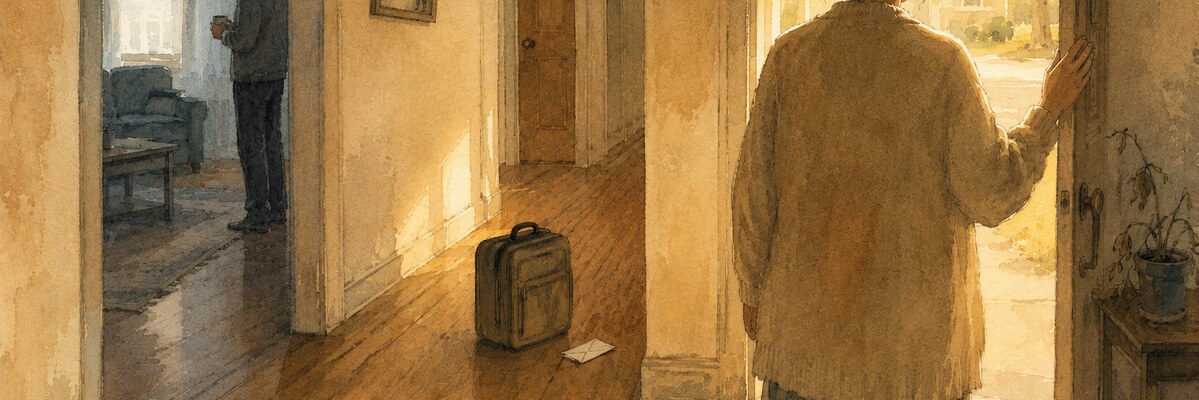
She tells him on a Tuesday after dinner. Calmly. With the kind of clarity that's been rehearsed for months. She's done. She's looked into the logistics. She's thought about the kids. She's not angry. She's not crying. She's just done.
And he stares at her, his coffee going cold, and he hears the word done in his head and it doesn't connect to anything. They've been fine. They've been busy, but fine. They haven't fought in years. She seemed quiet recently, but he chalked that up to work. He doesn't have a frame for what she's saying. He'll think later, much later, about the question that comes out of his mouth first — but where is this coming from? — and realise that it was the most honest thing he could have said. He really, truly, didn't know.
The marriage therapist Michele Weiner-Davis has been seeing this exact conversation, with variations, for forty years. She gave the pattern its name in her 2001 book The Divorce Remedy: she called it walkaway wife syndrome. It isn't a clinical diagnosis. It's a descriptive label for an asymmetry that turns out, on closer inspection, to be unusually predictable. By the time he hears it, she's been deciding for years. By the time she tells him, she's almost always already left, internally, before the suitcase gets packed.
This is a piece about that asymmetry. What the pattern looks like on each side, what the data actually shows about who leaves whom and when, and — for couples who recognise themselves in some part of this — what the research consistently flags as the move that can still interrupt it.
The Statistics, Which Are Stranger Than People Expect
Most people, asked to guess who initiates more divorces, hesitate. Men leave for affairs, the cultural script says. Women want to stay and work it out.
The data has said the opposite for decades.
The cleanest single source is a 2000 paper by the economists Margaret Brinig and Douglas Allen in American Law and Economics Review, with the title "These Boots Are Made for Walking: Why Most Divorce Filers Are Women." Brinig and Allen analysed a dataset of US divorce filings and found that women file in approximately 66% of cases. The reason most people are surprised by this isn't because it's a small effect. It's because the cultural narrative has been pointed in the other direction for so long that the data has had to keep restating itself.
of US divorces are initiated by the wife (Brinig & Allen, 2000). The proportion is higher at midlife: an AARP 2004 study of divorce after age 40 found roughly the same figure, and more recent academic work, including Michael Rosenfeld's 2015 American Sociological Association analysis, has put the number at 69% for heterosexual marriages specifically.
The 2004 AARP study, The Divorce Experience: A Study of Divorce at Midlife and Beyond, surveyed over 1,100 adults aged 40-79 who had divorced in that age range. Same result. Two-thirds of midlife and later-life divorces were initiated by the wife. The most common reason wives gave for filing wasn't infidelity, abuse, or addiction — although those were present in some cases. It was something quieter: a long-accumulated sense that the marriage had stopped containing the things they wanted from it, and that they had asked for change in many ways for many years and had stopped expecting it to happen.
What's striking, across both studies and across the broader literature, isn't the figure itself. It's the asymmetry it implies. If two-thirds of long-term marriages end with the wife filing, and if those wives have, on average, been considering leaving for years, then there's a corresponding two-thirds of husbands who didn't see it coming. The walkaway pattern isn't an edge case. It's the median.
What the Pattern Looks Like From Each Side
The defining feature of walkaway wife syndrome isn't the leaving. It's the dissonance between the two partners' experiences of the marriage in the years before the leaving.
From her side: a long, slow, accumulating series of unmet bids for connection, unaddressed grievances, requests for change that were either dismissed or absorbed with promises that didn't translate into behaviour. She raised the issue. She raised it many times. At some point, she stopped raising it — not because she felt it had been resolved, but because she stopped expecting raising it to matter. She began, quietly, to build an emotional life that didn't depend on the marriage. Friendships. Work. Hobbies. Walking. Reading. The kids. A garden. Often she didn't realise she was doing it. She just noticed, eventually, that she was happier in the parts of her life that didn't include him.
From his side: a marriage that had gotten quieter and easier. The fighting decreased. The complaining stopped. She seemed less stressed about the small things — the dishes, the schedule, the in-laws, the spending — that used to generate conflict. He read this, plausibly and not unreasonably, as evidence that the marriage had matured. He thought they'd reached the calmer stage that long marriages are supposed to reach. He didn't notice the conversations getting shorter, because the absence of something is harder to notice than the presence of it. He didn't notice she'd stopped reaching for him, because being not-reached-for doesn't register the way being reached-for does.
The cleanest way to summarise the asymmetry: she experienced years of trying. He experienced years of peace. Both descriptions are accurate to the felt experience of each partner. They are describing the same period of marriage.
The Four Phases of the Pattern
Weiner-Davis, in her clinical work and her subsequent books, has sketched the pattern as moving through roughly four phases. They aren't a clinical taxonomy. They're a description that tracks the felt experience of women who, in retrospect, described their own walkaway in roughly these terms.
The Asking Phase
She raises the issues directly. Sometimes loudly. Often repeatedly. The complaints are specific — about feeling unheard, about division of labour, about the absence of small attentions, about the lack of conversation, about sex, about parenting, about money. The husband, depending on his style, either argues, dismisses, defers, or apologises and doesn't change. The asking phase can last years. It's also the phase a husband is most likely to remember, often as evidence that "she was always complaining." The asking, in his memory, is the bad version of the marriage. In her memory, it was the version that still had her in it.
The Resignation Phase
She gives up on asking, but hasn't yet given up on the marriage. The complaints decrease, not because the underlying issues have resolved but because she has concluded that voicing them is not the route to addressing them. The marriage gets visibly easier from the husband's side. From hers, it gets emptier. She begins to put the energy she had previously been spending trying to change the relationship into building parts of her own life that don't depend on it. The husband reads this as healthy independence. She reads it as the only place her effort still yields returns.
The Internal Decision
At some point, often unmarked by any external event, she decides she's done. The decision is rarely dramatic. It's more like a settled clarity that arrives in pieces over months — sometimes during a particular conversation that goes badly, sometimes during an ordinary Tuesday in which she notices that she has been thinking, for years now, in the first person singular about the next decade of her life. From the moment of decision forward, the relationship is in wind-down mode internally, even if externally nothing visible has changed — the same shape that's been named in fast-forward as banksying, where the private decision and the calm exit are compressed into weeks rather than years. She begins to think practically. Logistics. Finances. Living arrangements. Kids. When to say something.
The Announcement
By the time she tells him, the decision is typically settled. The conversation that he experiences as a sudden announcement is, on her side, the last step in a process that has been running for several years. This is the phase in which most husbands first realise something is wrong. The cruel mathematical consequence: by the time they have the information, the window during which the decision could have been changed has usually already closed.
Why Most Husbands Don't See It Coming
It would be tempting to attribute the asymmetry purely to inattention. It would also be wrong. There are structural reasons the pattern is hard for the husband to perceive in real time, even if he is genuinely paying attention.
The first reason is that most of what's happening is the absence of things, not the presence of things. Decreased asking. Decreased bidding for connection. Decreased follow-up after an argument. Absences are inherently harder to register than presences. Nobody walks past a quiet house and consciously notices the absence of barking. We notice barking we hear, not barking we don't.
The second is that men in long marriages have been consistently shown to over-rate the health of their marriages relative to their wives' ratings. This isn't a moral failure; it's a measurement bias that shows up reliably in marital satisfaction surveys. The husband's read of the marriage is, in aggregate, a positive few points off the truth. This makes the wife's quieter behaviour look, from his vantage point, like further confirmation of an already-positive baseline.
The third is that the version of "the conversation about the marriage" that men typically register is the loud version — fights, complaints, named issues. The version of the conversation that walkaway wives are actually having with their husbands during the resignation phase is much quieter and more in the texture of daily interaction. We've written about the small-bid texture in bird theory, and the long-arc version of the same disengagement under another name in quiet quitting your marriage. The walkaway-wife pattern is the quiet-quitting pattern with the divorce attached.
The fourth, and most painful one, is that the husband is often genuinely paying attention to something else. Work pressure. Health issues. Older parents. Children's lives. Real and legitimate other concerns. He isn't ignoring the marriage; he's quietly trusting that the marriage is the part of his life that doesn't currently need attention. By the time he learns otherwise, the trust has already been broken in a way he didn't know was happening.
Sue Johnson and the Attachment Injury Frame
The most empirically robust frame for what's happening underneath walkaway-wife syndrome doesn't come from Weiner-Davis. It comes from the work of Sue Johnson, founder of Emotionally Focused Therapy, whose research on couples has accumulated the strongest outcome data of any couples-therapy approach.
Johnson's framework calls the small, accumulating wounds attachment injuries — moments at which one partner reaches for the other in a moment of need and doesn't get the response they needed. Each individual injury is usually small. The accumulated load isn't. Johnson's clinical observation, supported by her research, is that there is a threshold beyond which the cost of one more attempt to reach feels higher than the cost of leaving — and that women in long marriages tend to reach this threshold earlier than their husbands, partly because they have been doing more of the reaching all along.
This frame is useful because it locates the problem somewhere more recoverable than "she just stopped loving me" or "he just stopped caring." The problem is a specific kind of accumulated load. Specific kinds of repair, applied early enough and consistently enough, can reduce the load. Repair attempts — Gottman's term for the small in-flight moves that interrupt conflict — are one mechanism. Sustained behavioural change in the everyday texture of attention is another. What doesn't work, reliably, in either Johnson's data or Weiner-Davis's clinical experience, is a single dramatic gesture after the decision has been made. The gesture doesn't address the load. The load was built across years.
What Husbands Can Actually Do
If a husband is reading this article and feeling a small uncomfortable recognition, the move that works isn't dramatic. It's a small set of behavioural changes, sustained without being performative.
1. Stop being a problem to be navigated.
The cleanest single behavioural shift, supported across Weiner-Davis's clinical work and Johnson's EFT research, is this: stop being the thing your wife has to manage around. The quiet phase of the pattern is, in a real sense, your wife having become an expert at routing around you. Becoming actively interested in her — in what she's been thinking about, in what she's been quietly enjoying, in what she's stopped sharing — without making the interest a project or a campaign, is the single most under-rated intervention. Curiosity, sustained over months, does more than apology. The apology she may have wanted years ago. The curiosity she may have stopped expecting and would be quietly amazed to receive.
2. Notice what she stopped asking for, and start providing it without being asked.
This is harder than it sounds, because by the time you read this, much of the asking has stopped. The list of things she gave up on hasn't been refreshed in years. It takes paying attention — to small frictions in daily life she absorbs without comment, to small joys she has elsewhere that you could have been part of — to reconstruct the list. The reconstructed list is usually shorter than the husband fears. Most walkaway wives are not asking for a transformed husband. They are asking for the husband they had occasional glimpses of years ago to show up consistently. If the division-of-labour piece is high on the reconstructed list, taking it off her plate without re-routing it through her — for instance, by handing the weekly chore split to a random draw rather than asking her to delegate them — removes the mental-load tax that the asking phase was largely about.
3. Get good at receiving repair attempts.
If she does try once more — if she raises something specific, or names a small disappointment, or makes a request — the most important behavioural variable is not your response. It's whether she felt heard, all the way down, even if the issue itself takes time to resolve. The most common failure mode is the husband, anxious about the criticism, defending himself before fully receiving what's being said. That defence reads, in the moment, as further confirmation that voicing doesn't work. One sustained instance of being received — one — does more to interrupt the resignation phase than ten apologies that fold back into the same pattern.
4. Get help, sooner rather than later.
If you've recognised yourselves in this article and she has not yet announced anything, that's the window. EFT-trained couples therapists have the strongest outcome data on this specific pattern, partly because the framework gives both partners a way to name what's been happening that doesn't require either side to be the villain. Once the announcement has happened, the window is much smaller and the work is much harder. The cost of pre-emptive help is much lower than the cost of crisis help.
What Wives in the Resignation Phase Should Know
The pattern described here is real. It is also not destiny. Many wives in phase two — the resignation phase — describe, in retrospect, a period in which they were already 80% out and would have stayed if their husband had registered the depth of what was happening before phase three closed the window. There is a version of phase two that ends in decision and a version that ends in real repair. The variable that distinguishes them, more than any other, is whether the husband becomes capable of receiving what's been happening before she stops being willing to tell him.
This is also true: leaving is sometimes the right answer. Not every walkaway wife is leaving a marriage that could have been saved. Some marriages, by the time phase three arrives, contain damage that no amount of late attentiveness can repair. The pattern described in this article is a description, not a prescription. The decision about whether to stay or leave is yours, and either decision can be made well.
One Last Thought
The reason the walkaway pattern is so painful, from both sides, is that it doesn't look like a failure of love. It looks like two people who genuinely meant well and ended up, slowly and without obvious markers, in completely different marriages from each other. She was in the marriage she was trying to fix. He was in the marriage he thought they'd reached the calm of. By the time they were both in the same marriage again, the marriage was over.
The interruption to the pattern, when it works, is rarely heroic. It's usually small, sustained, and slightly humbling. It's the husband who has noticed, often years before any conversation happens, that his wife has gone quieter than she used to be, and who treats the quiet as information rather than as a feature. It's the wife who, before she gives up on asking, lets him know once more that she's preparing to give up — clearly and specifically, in a way that asks something concrete of him. It's the conversation that happens on Tuesday at 9 p.m., before the conversation that happens on the other Tuesday, four years later, that would otherwise have arrived. It's the small refusal, by both of them, to let the pattern run on autopilot the rest of the way through.
If you've recognised yourselves in some part of this, the right time to do something is much earlier than feels necessary, and much earlier than it ever feels urgent.
One last note: the walkaway often emerges from a recurring micro-pattern that's recently been named — the partner who repeatedly goes quiet for stretches and then, when they reappear, refuses to acknowledge that the silence happened. That's ghostlighting, and inside a long marriage it's especially insidious because the silences are shorter (a weekend, three days) but the cumulative effect over years is exactly the slow erosion this article describes. If the pattern sounds familiar, that piece names what's been quietly happening.
The conversation that interrupts a walkaway pattern is usually a slow, present one before it's a dramatic one. Heart to Heart is 195 turn-by-turn questions designed for exactly that — the kind of phone-free evening where the asking can be heard. Browser-based, no accounts. Phones in another room — that's the only rule. It's part of Unravel: Couple Games, a small collection of offline games for two.
Try Heart to Heart