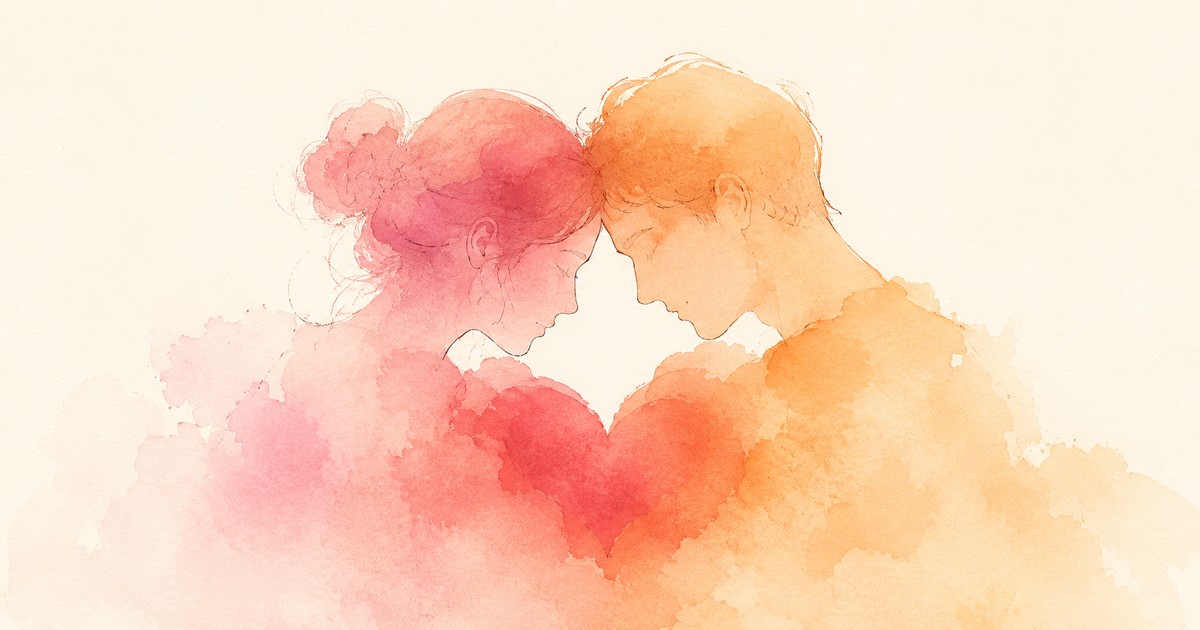
Somewhere on this planet, right now, someone is writing u + me = ♥ in the corner of a notebook, or a foggy car window, or a text they'll delete before sending. It's the most disposable little equation in the world. And it's also, weirdly, one of the most accurate things anyone has ever said about love, because relationship scientists have spent forty years quietly proving that the math checks out.
Not the heart part, exactly. The us part. It turns out that the moment two people stop being "you" and "me" and start being "we" is not just a cute milestone. It's one of the most reliable fingerprints of a relationship that's actually going to make it. Researchers even have a slightly clunky word for it: we-ness. And once you know it's there, you start hearing it everywhere.
The Smallest Word That Predicts the Biggest Things
Listen to any couple talk for five minutes and you can hear which team they're on. One couple says: "I paid for the wedding, so I get to decide." Another says: "We're still paying that off, honestly." Same money, completely different marriage. The difference is a pronoun.
Psychologists call the first-person-plural words (we, us, our, ours) "we-talk," and they treat them as a kind of accidental confession. You don't choose them; they leak out. When your brain has genuinely merged your life with someone else's, "we" is simply the truest word available, and it shows up on its own. When it hasn't, you keep reaching for "I" and "you," and the seam between you stays visible.
In 2019, a team led by Alexander Karan in Megan Robbins' lab at the University of California, Riverside, pulled together 30 separate studies covering nearly 5,300 people to ask a blunt question: does saying "we" actually matter? The pooled answer was yes, and across the board. Greater we-talk was associated with higher relationship satisfaction, more positive behaviour between partners, better mental health, better physical health, and even healthier habits (UC Riverside News; Journal of Social and Personal Relationships).
There's a lovely twist buried in that data, too. It wasn't so much your own "we" that predicted a strong relationship. It was your partner's. Hearing the person you love casually describe your shared life as "ours" turns out to be one of the warmest signals there is. It's the linguistic version of them reaching for your hand without thinking about it.
You can't fake "we." By the time it's on your tongue by default, the merging has already happened somewhere deeper.
Why "We" Wins the Argument
The most impressive thing about we-ness isn't how couples talk when everything's rosy. It's how they talk when it isn't.
Benjamin Seider, Robert Levenson and colleagues brought 154 middle-aged and older couples into a lab, wired them up to monitors, and asked each pair to spend fifteen minutes hashing out an ongoing disagreement. Then they went back through the transcripts and counted pronouns, sorting them into "we-ness" words (we, us, our) and "separateness" words (I, me, you, your) (Psychology and Aging, 2009).
The couples who used more "we" language during the fight had a visibly better argument. Their bodies were calmer (lower cardiovascular arousal) and their behaviour was warmer and less hostile. The couples who leaned on "me" and "you" showed the opposite: more emotional negativity and a more agitated physiology. Same conflict, different pronouns, measurably different nervous systems.
It makes intuitive sense once you say it out loud. "You always do this" puts your partner on trial. "How do we keep ending up here?" puts the problem on the table between you, where you can both look at it side by side instead of across a divide. The word "we" quietly re-seats two opponents onto the same side. (Interestingly, the same researchers found that older couples used "we" more than middle-aged ones, as if a shared identity is partly a thing you build over decades of repair.)
The Study That Could See the Future
If that all sounds a bit soft, here's the finding that tends to make people sit up. In 1992, Kim Buehlman, John Gottman and Lynn Katz sat down with 52 married couples and simply asked them to tell the story of their relationship: how they met, how they decided to marry, what hard times they'd been through. No conflict task, no questionnaire. Just: tell us your story.
Then they coded those stories for a handful of qualities and used them to predict which couples would still be together three years later. The accuracy was startling: over 94% (The Gottman Institute).
And one of the qualities doing the predicting was, again, we-ness, the sense that the couple experienced their history as a shared adventure rather than two résumés that happened to overlap. Partners who expressed fondness for each other, spoke with less negativity, and conveyed that feeling of "us against the world" were far less likely to divorce. The couples heading for trouble told the same life story as two separate narrators, each a little defended, each subtly keeping score. The couples who lasted told it as one story, in the first-person plural.
That's the thing about "we." It's not just a snapshot of how you feel today. It's a quiet forecast.
The Beautiful Idea Underneath It: Self-Expansion
So why would a pronoun carry so much weight? The deepest answer comes from a married pair of psychologists, Arthur and Elaine Aron, who in 1986 proposed one of the most romantic theories in all of psychology, and then spent decades backing it up with data. They called it the self-expansion model (self-expansion model).
The core idea is this: humans are motivated to grow, to expand who we are, what we can do, and how we see the world. And one of the most powerful ways we expand is by falling in love. When you form a close bond, you don't just add a person to your life. You start folding their identity, resources, experiences and perspectives into your own sense of self. Their friends become your friends. Their taste in music leaks into your playlists. Their loss feels like your loss. Psychologists call this "including the other in the self," and it is, almost literally, the "u + me = ♥" doodle rendered as science.
The Arons even built a way to measure it that looks exactly like our cover: the Inclusion of Other in the Self Scale, a row of pictures showing two circles that overlap more and more, from barely touching to almost completely merged. People just point to the picture that matches how close they feel. And the more overlap a person reports, the more satisfied, committed and durable their relationship tends to be. The overlapping circles aren't a metaphor for love. They're a validated instrument for it.
This is what "we-ness" is underneath the language: not two people standing very close, but two selves that genuinely share territory. The word "we" is just the sound that overlap makes.
How Love Keeps Expanding (or Quietly Stops)
Here's the part of self-expansion research that every long-term couple should have tattooed somewhere discreet. That expanding feeling (the rush of becoming more because of another person) is strongest at the start, when everything about them is new. Early love is a firehose of self-expansion. It's why the first months feel like your world is doubling in size.
The problem is that novelty runs out. You learn their stories, their body, their coffee order, the exact route their moods take. The expansion slows to a trickle, and what rushes in to replace it is the quiet killer of long relationships: boredom. And boredom, it turns out, is not harmless. In one striking longitudinal study, couples who reported more boredom in year seven of their marriage were significantly less satisfied nine years later, in year sixteen, even after accounting for how happy they were to begin with (Tsapelas, Aron & Orbuch, summarised via the self-expansion research). A bored year seven was a warning shot for a distant year sixteen.
But the same research points straight to the antidote, and it's oddly hopeful. If falling in love expands the self through novelty, you can keep the feeling alive by deliberately doing new things together. The Arons' experiments showed that even couples doing brief, slightly awkward, novel-and-exciting tasks in a lab reported a bump in relationship quality afterward: the shared newness re-created a little of that early-days expansion. "We" isn't a state you reach and then coast on. It's a fire you keep feeding.
The Catch: We-ness Is Overlap, Not Erasure
It would be easy to read all this as "merge as hard as you can." It isn't. The healthiest version of we-ness is two circles that overlap generously while each stays a whole, intact circle, not one circle swallowing the other.
You've met the couple who lost themselves. Every sentence is "we," every opinion is joint, and somewhere in there two actual humans went quietly missing. Psychologists call that end of the spectrum enmeshment, and it's a real cost: when your entire identity is fused with someone else's, there's no you left to bring anything new to the us. Self-expansion needs two people who are still growing on their own, precisely so they have something fresh to fold into the shared self. The goal is a big warm middle, and two edges that are still your own.
So we-ness at its best sounds like "we're figuring out the money thing together" and also "I'm taking that pottery class I've wanted to do for years." Both. The couples who last aren't two people who became one person. They're two people who became a great third thing (an "us") without either of them disappearing.
How to Grow Your "We" on Purpose
We-ness can sound like something you either have or you don't, a chemistry thing. It isn't. It's built, mostly out of small, repeatable habits. Here's what the research quietly recommends.
1. Borrow the pronoun before you feel it
You don't have to wait until you feel like a perfect unit to talk like a team. Deliberately reframe shared problems in the plural: not "your overdraft" but "how are we going to handle this month," not "you need to deal with your mother" but "how do we want to handle the holidays." Language isn't just a readout of closeness; it nudges closeness along. Reach for "we" on the small stuff and your nervous system slowly starts to believe it on the big stuff.
2. Tell, and re-tell, your story as one story
Remember what Gottman's couples were really doing: narrating a shared history. Make time, every so often, to tell your origin story out loud together: how you met, the moment you knew, the hard patch you climbed out of. Couples who "glorify the struggle" ("that year was brutal, but we got through it") are building the exact us-against-the-world muscle the research prizes. You are, quite literally, authoring your we-ness one anecdote at a time.
3. Keep doing genuinely new things together
This is the self-expansion prescription, and it's the most fun one. The point isn't expensive; it's novel. Take the weird class, get lost in a new city, try the cuisine neither of you can pronounce, learn the dance badly. Shared novelty re-opens the tap of expansion and, crucially, ties the good feeling to your partner's face. A standing "we always try one new thing a month" habit is cheap insurance against the boredom that year-seven study warned about.
4. Keep knowing each other as you both change
The person you fell for is not the person sitting across from you now, thank goodness. We-ness decays quietly when partners stop updating their mental map of each other and start loving a slightly out-of-date version. The fix is curiosity that never fully retires: keep asking, keep noticing, keep being a little surprised. Knowing your partner in depth is the substrate that "including the other in the self" is built on: you can only fold in a self you actually understand. We wrote more about this in the "who knows me better" trend, which is really a game about exactly this map.
5. Protect the tiny moments, not just the big ones
Grand romantic gestures make good stories, but we-ness is mostly assembled out of micro-moments: the glance across a boring party, the inside joke, the "you have to see this" text. Gottman calls these bids for connection, and turning toward them, even sleepily, even at 40%, is how two people stay woven together over years. A thousand small "us" moments outperform one big one. It's the same quiet logic behind why small gestures beat grand ones: consistency is what the self actually expands around.
The Equation, Solved
Here's the thing about u + me = ♥. Read one way, it's saccharine, the stuff of key rings and bad tattoos. Read another way, it's an unusually honest description of what actually happens in a good relationship: two separate people run an operation on each other and come out the far side as a new quantity that didn't exist before. Not one of them absorbed into the other. Not two of them politely coexisting. A third thing, an us, with its own history, its own jokes, its own future it's rooting for.
You don't get there through a grand gesture. You get there through ten thousand tiny reps of choosing the plural: the shared "we're in this," the new thing tried together, the fight fought side by side instead of face to face, the story told as one. The "we" isn't the reward at the end. It's the practice that gets you there.
So the next time you catch yourself saying "we" without deciding to ("we should do that," "we've been meaning to," "we'll figure it out"), notice it. That little word is the sound of two circles finding their overlap. It's the equation, quietly solving itself.
And if you want a gentle, structured way to keep expanding into each other (to keep the map current and the middle warm), that's exactly what we built Heart to Heart for. It's a take-turns conversation game that walks the two of you, one calm question at a time, into the good, slightly-vulnerable territory where "you and me" quietly becomes "us." No pressure, no scorekeeping. Just the oldest self-expanding activity there is: getting to know the person you love a little more deeply than you did yesterday.
Grow your "we," one question at a time. Heart to Heart is a take-turns talking game that eases both of you into the good, slightly-vulnerable territory: what you want, what you fear, what "us" means to each of you. The simplest way to keep expanding into each other. It's part of Unravel: Couple Games, a small collection of offline games for two.
Play Heart to Heart