There's a specific silence that happens on camera when one half of a couple confidently answers "her favorite flower is… roses?" and the other half slowly turns to look at the lens. That silence is the entire appeal of the "who knows me better" trend — the couples-quiz format that took over feeds this year, where two people fire questions about each other and let the misses speak for themselves.
The format is older than the app. But 2026 gave it a second life: boyfriend-versus-best-friend showdowns, "spicy edition" decks people save for date night, parents quizzing each other across a kitchen island while the kids referee. The questions run from harmless (favorite color, go-to coffee order) to quietly loaded (who's more likely to start a fight, what am I insecure about). The fun is watching a couple discover, in real time and in public, the exact shape of the gap between how well they think they know each other and how well they actually do.
It's worth understanding why it works — and what a low score does and doesn't mean — before you point a camera at your own relationship.
Why It's Suddenly Everywhere
A quiz is a perfect short-form story with no script: setup (the question), tension (will they get it), payoff (the reaction), all inside thirty seconds. TikTok then acts as an express lane — one format gets stitched, duetted and remixed into a thousand variations, so "who knows me better" mutates into couple editions, sibling editions, mom-versus-dad editions overnight.
It also has a useful double edge. Get every answer right and the video is a soft flex. Miss the easy ones and you've started a conversation you can't un-start, on camera. Both versions make good content, which is why the algorithm keeps feeding it back.
And it scratches a real itch. In a dating culture obsessed with naming things — situationships, soft launches, the ick — a quiz is the rare format that measures something concrete: do you have an accurate, current picture of this specific person? Most relationship content is vibes. This one keeps score.
What Gottman Would Say About Your Score
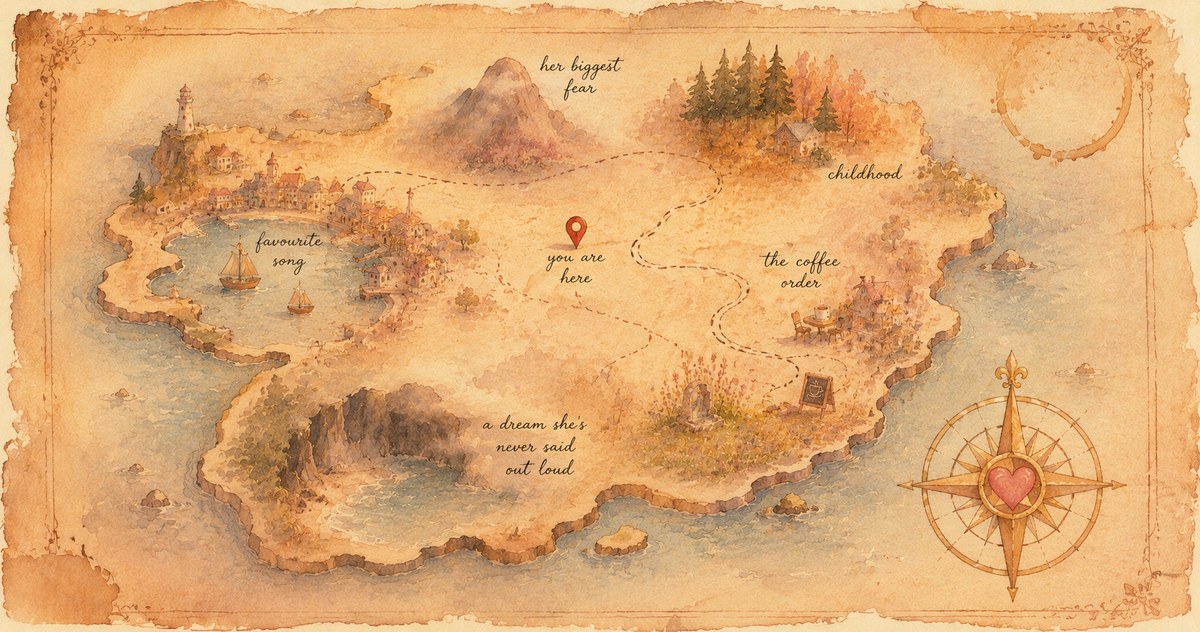
The psychologist John Gottman has a name for the thing the trend is secretly measuring: a love map. In Gottman's framework, your love map is the part of your brain where you store the details of your partner's inner world — their fears, their dreams, the name of the coworker who annoys them, the exact order they take their coffee (The Gottman Institute).
Couples with rich, regularly-updated love maps weather stress better. Gottman's newlywed research found that 67% of couples experienced a steep drop in relationship satisfaction after the birth of their first child — and the third who didn't were largely the couples who had built detailed love maps of each other beforehand (John Gottman, The Seven Principles for Making Marriage Work). Knowing each other's inner worlds wasn't a nice-to-have; it was the buffer.
So a couples quiz is, accidentally, a love-map audit. Which is exactly why a low score stings — it doesn't feel like a game, it feels like evidence.
Why You "Failed" (It's Not What You Think)
Here's the reframe that takes the sting out: missing a question about a favorite is almost never a referendum on love. It usually comes down to three things.
- Maps go stale. You learned your partner's favorite movie in year one and never updated the file. People change; the map didn't get the memo.
- You stopped asking. Long-term couples narrate logistics — did you call the plumber, are we out of oat milk — far more than interiors. The quiz simply exposes the questions you quietly stopped asking.
- Recency beats depth on camera. You might know your partner's deepest fear and still blank on their current favorite song. The trend rewards trivia. Intimacy isn't trivia.
A love map is not innate knowledge you either have or don't have. It's a document you maintain. Missing a question isn't failing the test — it's the test telling you which page is out of date.
The Hidden Reason It Feels Good (Even When You Lose)
There's a second mechanism running underneath the laughter. Decades of research by psychologist Arthur Aron on self-expansion found that novel, shared, mildly challenging activities make relationships feel more alive — they reintroduce the discovery that defined the early days, once routine has sanded it down.
A quiz is a tiny self-expansion event. You learn something new about someone you assumed you'd finished learning, and that little jolt of "wait — really?" is the same thing that makes couples who try new activities together report higher satisfaction. It's also why Aron's other famous experiment, the 36 questions, still works decades later. Same engine: structured curiosity, taking turns, paying attention.
How to Actually Play It (Without Starting a Fight)
- Take turns, and answer about yourself sometimes too. It's a trade, not an interrogation.
- Drop the scoreboard energy. The score is the least interesting output. The interesting part is the follow-up: "why did you think I'd say that?"
- Mix the registers. An all-spicy deck becomes a stress test; an all-favorites deck stays shallow. Alternate easy → deep → easy. (The question lists below are built this way.)
- Treat a wrong answer as a gift. "You actually don't like that anymore?" is the start of an update, not the end of an argument.
- Don't film the hard ones. Some questions deserve a kitchen table, not an algorithm.
The Questions Worth Asking
If you want to actually run this — on a date night, not for the feed — you'll need better material than the recycled set that's been circling Pinterest since 2014. A few of ours, sorted so you're not stuck asking favorite-color forever:
- 80 "how well do you know me" questions for couples, sorted by depth — the partner-knowledge core of this whole trend.
- The couples quiz: 50 questions in four categories, each one surfacing a different layer.
- 75 funny questions — including the TikTok-style ones that secretly reveal real things.
- 150 would-you-rather questions for a lighter warm-up before the deep ones.
The trend, when you strip it down, is basically a game someone forgot to write rules for. Unravel's Guess Me is that game with the rules put back: you each answer honestly first, then guess what the other person said — so a wrong guess turns into "oh, tell me more" instead of "how could you not know that." Same dopamine, none of the on-camera ambush.
Because the couples who look good doing this trend were never the ones who got every answer right. They're the ones who laugh at the misses, ask the follow-up, and treat the gaps as the most interesting thing on the table. A relationship isn't a quiz you pass once. It's a map you keep redrawing — and the redrawing is the entire point.
Want to actually play it tonight? Unravel's Guess Me is the "who knows me better" trend with rules: you both answer honestly, then guess each other's answers. Wrong guesses turn into real conversations — no camera, no scoreboard, just the two of you finding out what's changed. It's part of Unravel: Couple Games, a small collection of offline games for two.
Play Guess Me