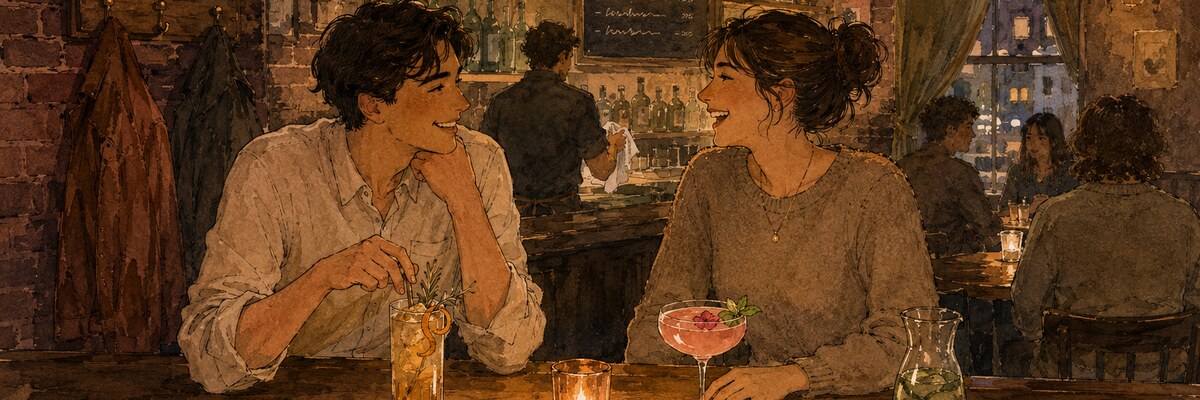
It's Friday night. You're at a bar. You're on a first date. The drinks menu arrives, and one of you says — completely casually — "I think I'll just have a soda water, actually." The other one pauses for half a second, then says: "Yeah, me too." And the date that's about to happen is now a slightly different date than the one either of you was expecting.
Welcome to sober dating, which in 2026 has gone from a niche choice into something close to a generational default. The reasons aren't only — or even mostly — about recovery. Younger adults are drinking measurably less than their predecessors did at the same age. Major dating apps now offer non-drinker preference filters. Non-alcoholic bars are opening in cities that didn't have one even three years ago. And a lot of people who do still drink are picking specific dates — first ones, important ones — to do without alcohol, because they've quietly figured out that the buffer they used to think they wanted is actually the thing that was making it hardest to tell whether anyone was real. Sober dating sits next to the broader slow dating movement of 2026 as a sibling reaction — both are about removing the compressions (chemical, algorithmic) that make the early stage of a relationship harder to read.
This is what's actually going on with sober dating in 2026, what it reveals about the way alcohol has been doing the social work in dating for the last hundred years, and how to do it well — whether you're on a first date, in a long relationship, or trying to explain across the table that you'll have the soda water, thanks.
The Numbers Behind the Trend
Sober dating didn't get popular because of a viral TikTok. It got popular because the underlying drinking culture has been shifting for a decade, and the dating culture has finally caught up.
72% → 62%
Share of U.S. adults aged 18–34 who report drinking alcohol. Gallup's 2023 polling shows the figure has fallen by 10 percentage points over two decades (from 72% in 2001–03 to 62% in 2021–23), with frequency of drinking among those who still drink also declining. Similar declines show up across most high-income countries.
$1B+
U.S. non-alcoholic beverage market by mid-2024, per IWSR Drinks Market Analysis, growing at 25%+ year over year — faster than any other category of beverage. Categories that didn't really exist in 2018 (NA spirits, hop water, functional mocktails) now anchor entire bar menus.
"Sober" as a filter
Most major dating apps now expose drinking habits as a profile field or filter — Hinge, Bumble, OkCupid, and Match all let users specify drinking preferences and screen accordingly, with several apps expanding sober-friendly options between 2023 and 2025. Hinge's annual D.A.T.E. Report has documented a growing share of Gen Z daters listing low or non-drinking preferences relative to older cohorts.
2025 advisory
The U.S. Surgeon General's January 2025 advisory on alcohol and cancer risk linked even moderate drinking to elevated cancer rates and called for warning labels on alcoholic beverages — the first such recommendation in 36 years. The advisory has been credited with accelerating an already-underway cultural shift in how moderate drinking is perceived.
None of this is a campaign. It's a quiet realignment, with the kind of momentum cultural shifts get when everything happens at once and reinforces itself: less drinking → more NA options → more sober-friendly venues → more sober dates → more people thinking maybe they don't need the drinks after all.
What Alcohol Was Actually Doing on a Date
To understand why sober dating reveals things drinking dates don't, it helps to look honestly at what the drink in your hand was doing. It wasn't, mostly, getting you drunk. It was performing five specific functions, often without anyone noticing:
- Something to do with your hands. A glass occupies fingers that would otherwise be visibly nervous.
- A pacing tool. Sips create natural pauses; ordering creates micro-breaks; finishing a drink is a tidy unit of conversation.
- A pretext to stay or leave. "One more drink?" and "actually, I should head out" are both attached to the rhythm of glass-emptying.
- A buffer between you and your own nervous system. The first sip of alcohol on a date reliably reduces social anxiety; the literature on alcohol's anxiolytic effects has documented this for decades.
- A buffer between you and the other person. Things that would feel pointed at zero drinks feel softened at one. Things that would feel hopeless at zero feel survivable at three.
None of that is necessarily bad — humans have used social lubricants for ten thousand years for genuinely useful reasons. But when you remove all five of those functions at once, what you get is not a worse date. It's a much more information-rich date. There's nowhere for either of you to hide. The compatibility question stops being "did we have chemistry after two drinks" and becomes "did anything actually happen in the room." Both questions are valid; they're just measuring different things.
What Sober Dating Actually Reveals
The most common feedback from people who've switched to sober dating after years of drinking dates is some version of: I figured it out faster. Specifically:
You can tell whether you actually want to be there. Alcohol creates a window of mild euphoria roughly 15–45 minutes in, during which any company is more enjoyable. That window can disguise dates you'd otherwise have left an hour earlier. Without it, the question of whether you want to stay is settled honestly, usually within the first 20 minutes — and most people, after some initial adjustment, report this as a relief rather than a loss.
You notice what they're actually like. The first 90 minutes of a sober date are essentially the data you would have gotten on a drinking date but distributed across three or four hours of accumulated alcohol-softened judgment. You see how they handle silence. You see whether they ask follow-up questions. You see whether they're curious about you in any granular way. None of these are visible through two drinks of distance.
You remember what was said. A surprising number of "great" drinking dates produce memories the next morning of having had a great time and almost no specific recall of what was discussed. Sober dates produce both the great time and the conversation. The relationship that eventually gets built on top of those conversations is a relationship; the relationship built on top of forgotten conversations is more frequently a series of pleasant first impressions that don't accrete.
The chemistry, when it's there, is unmistakable. One of the more counterintuitive findings: people frequently report that the chemistry they thought required alcohol to surface is actually more visible without it. What alcohol was producing wasn't chemistry; it was the warm fog that resembled chemistry. Real chemistry, the kind that builds across multiple dates, registers even more clearly when there's no fog. This is, frankly, why so many people start preferring sober dating once they've tried it for a few months.
How to Actually Do It
Some practical guidance, calibrated to where you are in the dating arc.
For first dates: pick the venue, not the drink.
The hardest part of sober first dates isn't ordering the soda water; it's choosing a venue where doing so feels normal rather than like you're making a statement. Speciality coffee shops, NA bars (most major cities have at least one now), walks in parks, museum lobbies, board game cafes, bookshops with cafe seating, weekend farmer's markets. The principle: pick a place where the activity provides natural rhythm and conversation, so neither of you is depending on the drink to do that work.
For telling them you don't drink: short is better.
"I'm not drinking, but get whatever you want" is a complete sentence. You don't owe a back-story unless you want to share one. The vast majority of dating partners react neutrally or appreciatively — partly because not drinking has lost most of its social stigma since 2022 or so, and partly because dates increasingly assume they might not be drinking, and saying it first usually relaxes both of you. Partners who react badly are giving you information you'd have wanted later anyway.
For long-term couples: try a sober month together.
One of the more interesting trends is established couples — including ones with no problematic drinking — doing a one-month dry stretch together. Dry January is the well-known one; Sober October has been growing. The point isn't sobriety as a goal; it's visibility. Couples who do this consistently report that the texture of their evenings changes — more conversation, earlier bedtimes, slightly more sex, fewer of the foggy weeknights where each person was technically present but not really there. Some couples go back to drinking after the month, some stay sober for longer, and a small but real share decide they prefer their relationship without alcohol entirely. There's no wrong answer; the data the month produces is the point.
For the long conversation: surface it directly.
If you and your partner are at different drinking levels, especially after a long period of being more similar, sober dating doesn't fix the underlying conversation — it just delays it. Mismatched drinking is one of the most common low-grade sources of long-term relationship friction, and it almost always benefits from being explicitly named rather than danced around at dinners and parties. The conversation goes more honestly with structure — our funny questions list and the deeper "how well do you know me" deck both have entry points for this — but the conversation has to happen somehow.
The Loneliness, the Romance, and the Long Game
One thing sober dating reveals that earlier drinking dating didn't: how lonely a lot of people are, and how much of what was passing for romance was just the warmer side of alcohol's mood architecture. Some people, encountering this, find sober dating discouraging. Others find it clarifying — the loneliness was there the whole time; alcohol was just disguising it.
The longer-term version of the same observation: relationships built without alcohol as scaffolding tend to be more legible to themselves. The partners know each other more accurately; they remember the conversations that built the trust; they've watched each other handle silence, awkwardness, and disagreement without the chemical edit. Those relationships aren't automatically better, but they tend to be more known, in a way that drinking-anchored relationships sometimes aren't.
Which connects, slightly indirectly, to one of the broader dynamics we've written about: when long-term couples slide into the roommate marriage pattern, alcohol is often part of the architecture of how they got there. Drinks at dinner instead of conversation; one or two glasses in the evening instead of presence; the slow substitution of liquid comfort for the harder, smaller work of actually noticing each other. Sober dating in a long relationship can be one of the quieter ways back into something warmer — not because alcohol caused the drift, but because removing it removes one of the substitutes that was making the drift sustainable.
The Honest Closing Note
Sober dating isn't morally better than drinking dating. It's not a hierarchy. People can have great drinking dates, build beautiful relationships, and never need to do without alcohol to be honest with each other. But for a growing share of daters — particularly under 35 — the trade-off has tipped. The buffer that used to feel like the point increasingly feels like the obstacle. You see each other faster, fight cleaner, remember more, and figure out compatibility within a window short enough to spare you the dates that would have stretched for two months under softer conditions.
The first sober date is the hardest one. By the fourth or fifth, most people stop noticing they're doing it; the absence of alcohol stops being the topic and becomes the background, and the date itself fills the space. That's usually when the actual question — do I want to keep spending time with this person — becomes possible to answer without sitting on it for three weekends.
Frequently Asked
What if my date wants to drink and I don't?
Almost always fine. Order what you want; let them order what they want. The drinker–non-drinker first date is a much more comfortable encounter than reputation suggests, especially in 2026, when the pattern is common enough that nobody finds it remarkable. Tension arises when one or both people feel judged by the other — judged for drinking, or judged for not drinking. Treat it as preference, not virtue, and the gap disappears.
Are sober people more likely to be in recovery?
Less likely than the stereotype suggests. Multiple dating-platform surveys and broader generational drinking research point in the same direction — the largest cohort of sober daters appear to be sober curious rather than in formal recovery. Sober curious daters typically haven't had a problematic relationship with alcohol but have decided it's not adding enough to their lives to justify the cost (sleep, money, time, hangovers, health). Recovery is a meaningful subset of the sober dating population but not the majority. Don't assume; let people share their own reasons.
How do I know if I'm sober curious?
The simplest test: do you spend a meaningful share of your weekends recovering from the previous night, calculating how many drinks you had, or vaguely wondering whether you'd be sleeping better, exercising more, or saving money without alcohol — and not enjoying enough about drinking to feel the trade-off is worth it. If that resonates, you're already adjacent to sober curious. Most people who try a one-month dry stretch find that they either go back to drinking happily or naturally extend the dry stretch. Both are valid outcomes; the experiment is the answer.
Is non-alcoholic beer really alcohol-free?
Most NA beer contains less than 0.5% ABV, which is technically alcohol but below the threshold for most legal and dietary definitions of "alcoholic beverage." For comparison, a banana that's been ripening contains around 0.4% ABV. For people in formal recovery, NA beverages are sometimes triggering regardless of ABV content (taste association); for everyone else, NA beer is functionally alcohol-free. If you're unsure where you stand, NA spirits, sparkling waters, and dedicated NA cocktails are zero-ABV alternatives.
Are there dating apps just for sober people?
Yes — Loosid is the largest dedicated sober dating app, with users including both recovery community and sober curious daters. The broader-platform alternative is to use the drinking preference filters now standard on Hinge, Bumble, Match, and OkCupid, which let you screen at a less specialised level. For users in larger cities, mainstream apps with filters now often surface sober matches at acceptable rates, but specialised apps remain useful for people who want a community-feeling environment rather than just compatible drinking habits.
The drinks are optional. The conversation isn't. That's most of what sober dating in 2026 is figuring out — and most of why the people doing it are quietly recommending it to the next round of daters who are getting tired of forgetting how the night went.
Sober date in? Heart to Heart and Guess Me are both designed for two people on a couch with no alcohol carrying the conversation. Turn-by-turn questions, browser-based, no accounts, no sign-up. The structure does the social lubricant work the drinks used to do. It's part of Unravel: Couple Games, a small collection of offline games for two.
Try Heart to Heart