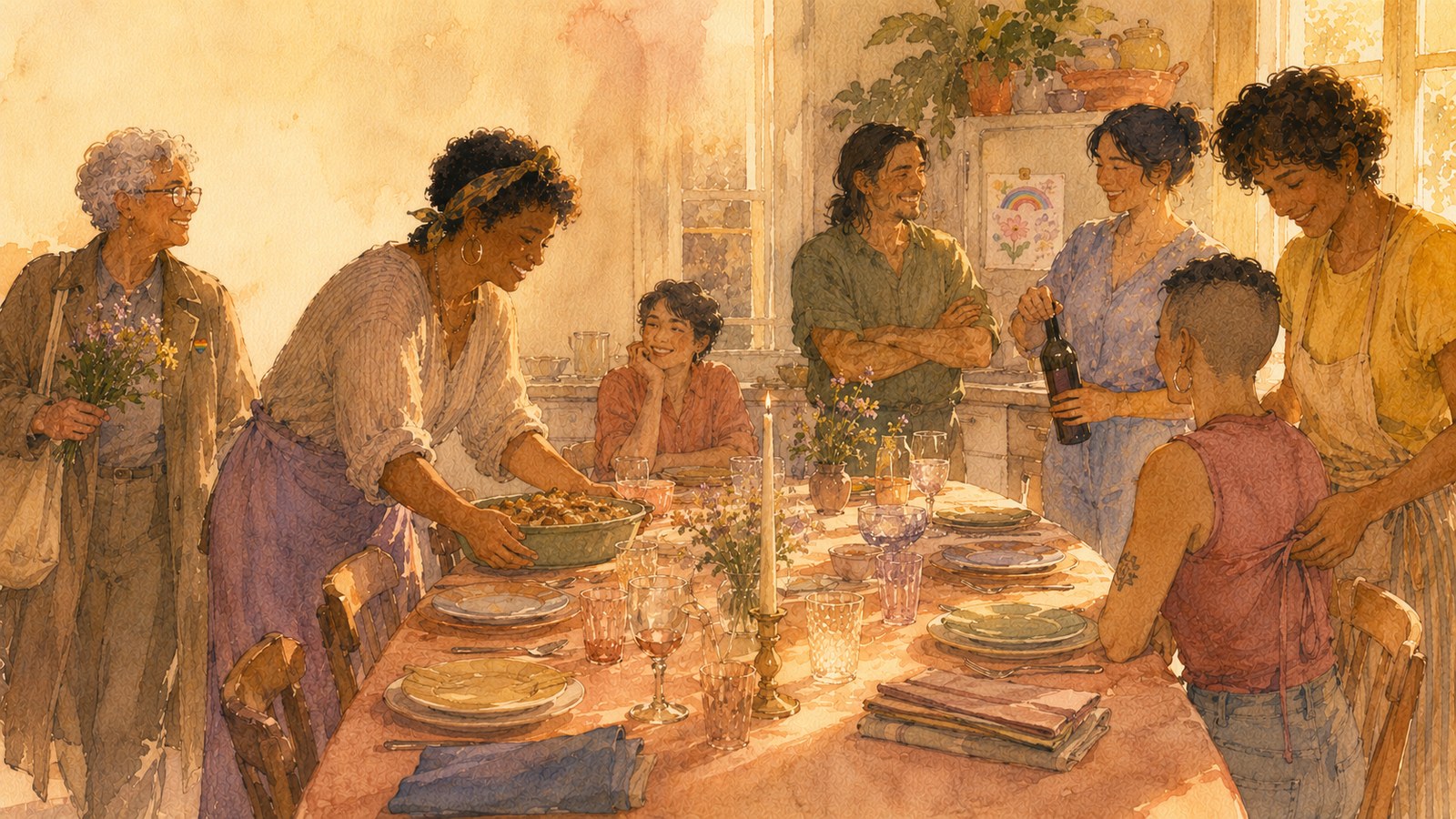
It's a Sunday in June. Six people are setting a long table in someone's small kitchen. Three of them have known each other for over a decade; two are newer; one is someone's ex who somehow stayed. Nobody at the table is anyone else's blood relative. They are doing what most cultures expect biological families to do — knowing each other's medication, remembering each other's anniversaries, asking how the difficult parent is doing, being the people who will get the hospital call. They have a word for what they are to each other. They are chosen family.
The word has been around longer than the current discourse suggests — it was named by an anthropologist in 1991, in a book of fieldwork conducted during the height of the AIDS crisis in San Francisco. But it's having a particular cultural moment now. The official Pride Month 2026 theme adopted by several US Pride organisations, Love Lives Here, centres chosen families explicitly. TikTok is full of it. The research literature has caught up with the practice, and the picture it paints is more interesting — and more nuanced — than most of the celebratory coverage manages to capture.
What follows is a careful look at where the term came from, what queer communities actually built that gave the term its shape, what the research says now about its real effects on mental health, and — for the reader who is not LGBTQ+ but is paying attention — what every couple can borrow from a framework that was developed under duress and has turned out to be quietly useful for anyone whose life doesn't fit the assumed map.
Pride 2026 · Love Lives Here
The official 2026 Pride theme adopted by the LA LGBT Center and a number of US Pride organisations, Love Lives Here, names chosen family directly: a celebration of "the people, relationships, and chosen families that continue to make our community feel like home." This is the first major Pride theme to treat chosen family as the centerpiece rather than as an aside.
Where the Term Came From
The phrase was named — not invented, but named — by the anthropologist Kath Weston in her 1991 book Families We Choose: Lesbians, Gays, Kinship, published by Columbia University Press. The book was based on ethnographic fieldwork Weston conducted in the San Francisco Bay Area in the mid-to-late 1980s — a period when the AIDS epidemic was killing tens of thousands of gay men, when biological families were in many cases refusing to nurse their own dying sons, when long-term partners had no legal standing to make medical decisions for each other, and when the work of caring for the sick and burying the dead was being done, on a scale almost no community in living memory has had to absorb, by networks of friends.
Weston's argument — which sounds obvious now and was contentious at the time inside anthropology — was that the gay and lesbian San Franciscans she was talking to were doing kinship work. They were not pretending to be families. They were constructing families that the dominant culture's definitions weren't equipped to recognise. "Kinship," Weston wrote, "begins to seem more like an effort and a choice than a permanent, unshakable bond or a birthright."
The practice Weston was naming was older than the book. The drag-ball houses of 1920s Harlem — the world later documented in the 1990 film Paris Is Burning — were structured explicitly as houses, with house mothers and house siblings, providing the kinship functions the participants' biological families had refused. The Latin term familia in mid-twentieth-century queer subculture, and the equivalent practices in lesbian feminist and bisexual subcultures of the 1970s and 80s, were doing the same kinship work under different names. Weston's contribution was to give the practice a name that could circulate beyond the subcultures that had invented it.
Why It Emerged Where It Did
Chosen family emerged in queer communities not because queer people are unusually creative about relationships — they are, but that's not the explanatory variable — but because queer people in the second half of the twentieth century faced a particular structural problem: the biological family, which most people in most cultures rely on as a kinship default, was disproportionately not available to them. Some had been thrown out as teenagers. Others were estranged by quieter means: silence at family dinners, exclusion from the holiday photo, refusal to acknowledge a partner of fifteen years. And then, in the 1980s, the AIDS crisis turned what had been a slow chronic exclusion into an acute survival problem: the same biological family that wouldn't come to your wedding also wouldn't come to your hospital bedside.
What the queer community in San Francisco built in response — and what Weston observed and named — was a parallel kinship system. Friends became next of kin. Ex-partners stayed in the structure. Houses contained multiple generations of found relations. The system wasn't romanticised. The people inside it were tired, often grieving, sometimes furious. But it worked: it did the things kinship is supposed to do.
Subsequent research has expanded the picture to other contexts where biological family is structurally less available. A 2020 study published in the International Journal of Environmental Research and Public Health on queer and transgender young adults in Canada found that chosen family was particularly central in the lives of young people whose families of origin had rejected them around their gender or sexuality. A 2021 study on LGBTQ+ refugees using text network analysis found that the concept of family was being explicitly remade by displaced queer people whose biological kin networks had been severed by migration and persecution. The pattern in the research is consistent: chosen family emerges most strongly where biological family is most missing.
What the Research Actually Says About the Mental-Health Benefits
This is where most popular coverage of chosen family overshoots, and where the more interesting story is.
The intuitive expectation, if you've read any of the celebratory articles, is that chosen family in LGBTQ+ samples should predict mental-health outcomes more strongly than biological family does. The 2021 study by Hull and Ortyl, Family of origin, not chosen family, predicts psychological health in a LGBTQ+ sample, published in Personality and Individual Differences, ran the numbers and found the opposite: in a sample of 175 LGBTQ+ adults, perceived support from family of origin — not chosen family — was the single strongest predictor of lower depression scores.
This sounds, on first read, like it undercuts the whole concept of chosen family as a protective factor. It doesn't. Read alongside the broader research, it does something more useful: it specifies what chosen family is actually doing.
The most coherent reading across the literature is that biological family acceptance, when it exists, is a strong protective factor for LGBTQ+ mental health — partly because biological family acceptance carries the social currency of the dominant culture's recognition, partly because the bond is older and predates one's sexuality coming up as a relational issue. Chosen family, by contrast, functions specifically as a buffer when biological family is absent or rejecting. The 2025 paper in Social Psychiatry and Psychiatric Epidemiology studying older LGBTQ+ adults found that chosen families showed measurably higher acceptance of sexual orientation, fewer negative interactions, and stronger felt commitment than biological families — but also slightly lower stability, because the deliberate basis of the bond is also what makes it vulnerable to drift if the deliberateness lapses.
The honest summary the research supports is this: chosen family is profoundly protective in the contexts where it matters most, and it doesn't make biological family irrelevant where biological family is functional. For someone whose biological family is loving and accepting, chosen family is an addition, not a substitute, and the addition matters. For someone whose biological family is absent or rejecting, chosen family is the structure that does the kinship work that no one else is doing, and the difference shows up in measurable mental-health outcomes.
What Distinguishes Chosen Family From "Really Close Friends"
This is the question that comes up most often in the comments under any article about the concept, and it has a real answer rather than a vibes-based one.
The distinguishing feature of chosen family, in the literature and in the way queer communities have practised it, isn't intensity of feeling. Close friends can love each other intensely. It's structural commitment — the practical, durable, defaulted-to organisation of life around the relationship. Five things tend to be present in chosen family that are usually absent in even very close friendship:
- Showing up uninvited in a crisis. Not "let me know if you need anything" — which is a polite refusal disguised as offer — but actually arriving, knowing what's needed, doing it. The crisis test is the most reliable diagnostic for whether a relationship is functioning as kin.
- Practical legal and bureaucratic standing. Listed as emergency contact. Named in a will. Holding a key. Knowing the medical history well enough to recite it to a triage nurse. These small bureaucratic facts are how, in any modern legal system, kinship gets recognised in practice.
- A non-mood-dependent rhythm. A regular call, a regular dinner, a regular trip that happens whether or not anyone particularly feels like it that week. Friendship gets to wait until people are in the right headspace. Family doesn't.
- Willingness to have the unflattering conversation. The conversation about the drinking, the bad partner, the work pattern that's hurting them. Friends often won't say it because the friendship can't carry the friction. Chosen family is defined partly by the willingness to risk friction for the other person's sake — and to receive it the other way.
- Inclusion in the planning of the future. Where the new flat is going to be. Whether the move to another city is a good idea. What to do about ageing parents. Friends might be told the decision. Chosen family is in the conversation that produces the decision.
Note what's not on the list: shared blood, shared household, shared romantic involvement, shared sexual orientation. The list is functional, not categorical. A relationship that does all five of these consistently over years is, by any non-trivial definition, kin — regardless of biology.
What Every Couple, Queer or Straight, Can Borrow From This
The cultural availability of the term chosen family is the single biggest thing it has to offer non-LGBTQ+ readers, because a lot of straight couples are doing kinship work with friends without quite giving themselves permission to call it that. The vocabulary you use for a relationship shapes how seriously you treat it. Calling someone my friend Sara versus my chosen sister Sara isn't a cosmetic difference; it changes what you'll default to when it gets hard to show up.
For couples specifically — and this is where the framework is particularly useful — chosen family solves a structural problem that the standard nuclear-couple template doesn't address well: the assumption that two people, in private, will provide the full range of relational support each of them needs across a lifetime. This was always a load-bearing fiction. It works less and less well as people live longer, geographic mobility scatters families further, social institutions thin out, and the cultural expectation of romantic partnership intensifies. The two of you, alone, in a room, are not actually enough for the long-term emotional and practical scaffolding of a life — and the relationships that try to be enough tend to buckle under the weight.
What chosen family offers a couple is a deliberate enlargement of the unit. Not in any romantic or sexual sense — although those configurations exist and are their own conversation — but in the sense that the couple's support unit is treated as larger than the couple. The Tuesday night dinner with the same four people every week. The friend who knows both partners well enough to call out when one of them is drifting. The chosen sibling who gets the call before the parent does when there's a hospital scare. The handful of people who would actually show up to help you move, not because you asked carefully, but because of course they would, because that's what you all do.
Building this takes years. It's incompatible with the friendship style that treats everyone as a season-long acquaintance. It also tends to be incompatible with the kind of relationship-as-fortress couple style we wrote about in roommate marriage, where two people gradually shrink the relational world to just each other and lose the wider scaffolding that makes the small daily disappointments survivable. The repair, in both cases, is in the same direction: deliberately maintain the wider structure even when the couple is going well, especially then, because the wider structure is what the couple will need when it isn't.
A Note on the Honest Politics of the Term
It's worth being direct about one thing. The term chosen family belongs, historically and politically, to a community that built it under conditions of rejection and crisis that most people borrowing it now have never faced. Using the language without that acknowledgment is a small kind of carelessness; treating the framework as if it were a generic life-hack invented for podcasts is a bigger one.
The way to use this framework respectfully, if you are not LGBTQ+ yourself, is more or less the way most borrowed vocabulary gets used carefully: know where it came from, name where it came from when it comes up, and be clear that the conditions that produced the practice are conditions a lot of queer people still navigate every day — including in 2026, including in the present rollback of LGBTQ+ rights in many parts of the US and elsewhere. The practice is portable. The history that produced it is not.
The 2026 Pride theme Love Lives Here is, partly, a response to that history still being live. Several US Republican governors — in Indiana, Tennessee, Alabama and elsewhere — have rebranded June as a month to celebrate "heterosexual marriage and families," explicitly in opposition to Pride. The chosen-family framing is, among other things, a quiet refusal to accept that frame: a way of saying that the families being celebrated this month are families regardless of which categories they fit into, and that the ones that exist outside the official categories often had to work harder to exist at all.
If You Want to Start Building One
The short version: pick three to five people who are already in your life and behave, over the next several years, as if they were family. The behaviour is more diagnostic than the declaration. You don't tell anyone they're now your chosen sister. You start showing up at the hospital, calling on the anniversary of the loss, listing them as your emergency contact, having the hard conversation. They start doing the same. After a few years of this, the relationship has done the kinship work, and the label is just the description of what is already true.
Three small starting moves that work better than the dramatic declaration.
Add the rhythm.
Pick one repeating thing — monthly dinner, weekly call, annual trip — and protect it the way you'd protect a recurring obligation rather than a social option. The reason this is the first move is that without a non-mood-dependent rhythm, the rest of the chosen-family functions are dependent on someone remembering to initiate, which is exactly the load that biological families don't make you carry. The rhythm carries the load instead.
Update the practical paperwork.
Quietly, without ceremony. If two of you have decided you're chosen siblings, you can quietly list each other as emergency contacts on the medical forms, name each other in wills, give each other a key. These small bureaucratic acts are where chosen family stops being a feeling and becomes a fact of the legal and practical record.
Have the awkward conversation when one of you is drifting.
Most close friendships dissolve quietly because the friction of saying "I feel like we've been less in touch and I miss you" feels disproportionate to the relationship's contract. Chosen family has a different contract: friction is allowed because the relationship is meant to be durable past one season. Having one slightly awkward repair conversation per couple of years, in a friendship you want to last decades, is one of the small practices that makes the difference between a friend you used to be close to and a person you still know.
For couples building shared chosen family — the same handful of people who are family to both partners, not separate friend pools — the additional practice that helps is treating these relationships as joint commitments rather than private ones. You both attend the dinner. You both remember the birthday. You both show up for the difficult moment. This is part of how a couple builds a relational world that is bigger than the two of you, which — across decades of research on long marriages — is one of the most reliable predictors of which long-term partnerships stay alive and which ones quietly shrink down to logistics.
What This Has to Do With June
The Pride Month framing of chosen family this year is not a marketing exercise. The reason the LA LGBT Center and a number of other Pride organisations have made Love Lives Here the 2026 theme is that the political and cultural environment for LGBTQ+ people in the US in mid-2026 is meaningfully more hostile than it was three or four years ago. A 2025 Gallup poll found that public support for same-sex relationships among Republican respondents dropped sharply for the first time in over a decade. State-level proclamations rebranding June as "heterosexual marriage and family month" exist now in several states. The Respect for Marriage Act, passed federally in 2022, protects same-sex marriages already entered, but the broader political climate that made marriage equality feel settled in 2015 is, in real and measurable ways, no longer settled.
Centring chosen family at Pride in 2026 is, in part, a reminder that the queer community has always built the structures it needed when the dominant culture refused to provide them. The lesson for everyone else watching from the outside — including this site's largely couples-and-relationships readership — is that the people who built chosen family did so because they had to, and the structure they built turned out to be one of the more humane ways anyone has figured out to organise care, attention, and presence around the people who actually show up for you.
That structure is now broadly available, as a word and as a practice, to anyone willing to do the work. The least we can do, this June, is name where it came from while we borrow it.
Frequently Asked
Can chosen family include biological family members?
Yes, and this is one of the most useful refinements of the term. The phrase isn't only about replacing biological family — it's about treating any kin relationship, including the ones you happen to be biologically related to, as something you actively choose into rather than something automatically owed. A sibling who is also a close friend you'd choose without the shared blood is part of your chosen family in the strong sense. A parent who you've decided to remain in active relationship with despite difficulty is, in a meaningful sense, chosen too. The framework's quiet radicalism is in applying the standard of deliberate, sustained, two-way care to all kin relationships, not in opposing biological family categorically.
How does chosen family work when you and your partner have different chosen families?
This is one of the practical questions that comes up most often in couples therapy with people who grew up with strong friend networks. The short version: it's fine, it's normal, and it's worth being deliberate about the overlap. Most long-term couples end up with three categories — your chosen family, my chosen family, and our chosen family. The third category is the one that tends to do the heaviest relational work for the partnership itself, because they're the people who know both of you and can hold the marriage as the unit they care about. Most couples don't actively build the third category; the ones who do tend to feel less alone in the long maintenance work of a partnership.
What's the difference between chosen family and a polycule?
They overlap but aren't the same. A polycule is a network of romantically and sexually connected people in a non-monogamous configuration. Chosen family is a broader concept that doesn't require romantic or sexual connection at all and frequently involves people who would describe themselves as platonic. Plenty of polycules function as chosen families to their members. Plenty of chosen families are entirely platonic. The Venn diagram overlaps, but neither contains the other.
Is "chosen family" being overused now that it's trending?
Some of the recent usage is loose — sometimes the word is reached for in places where close friend group would be more accurate, which dilutes the term. But the broader spread of the framework also means more people are practising the underlying behaviours: showing up uninvited in a crisis, listing friends as emergency contacts, building non-mood-dependent rhythms with people they're not related to. The trade-off — slight semantic dilution in exchange for wider practical uptake — strikes us as a good one. The framework was always going to outgrow the original community. The respectful version of the outgrowth is to keep the history visible while broadening the practice.
What if I don't have anyone I'd call chosen family yet?
The honest answer is that this is the situation many adults find themselves in, particularly in the wake of pandemic-era social thinning, geographic mobility, and the slow erosion of the institutions that used to manufacture incidental closeness (workplaces, religious communities, civic associations). Building chosen family from scratch is slow and frequently feels unrewarding for the first couple of years, because the relationships haven't yet had the time to develop the structural commitment that defines them. The realistic timeline is closer to several years of deliberate small investments with a few specific people than "find your people" in a season. If you're starting from low connection, the most useful first move is to pick one rhythm with one person and protect it for a year. That single durable Tuesday becomes the seed that the rest of the structure can grow around. It is, by any reasonable measure, late to start, and the only worse time to start is later.
If you're building the kind of slow, present conversation that chosen-family relationships run on — the kind where the people who are family to you actually find out what you're carrying — Heart to Heart is 195 turn-by-turn questions designed to slow a conversation down past where it usually stops. Use it with a partner, a chosen sibling, the friend who's becoming family. Phones face-down — that's the only rule. It's part of Unravel: Couple Games, a small collection of offline games for two.
Try Heart to Heart