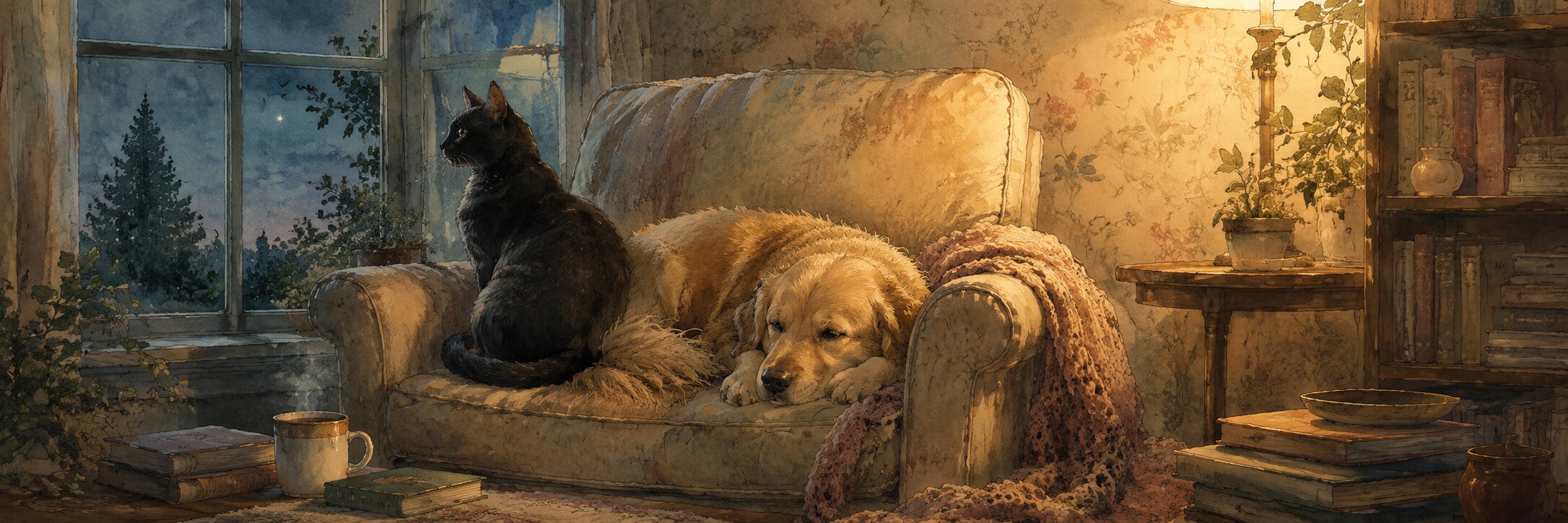
There's a particular kind of couple TikTok has decided to obsess over. One of them texts back in two minutes with five emojis. The other one takes four hours and replies with a single sentence that somehow makes the first person's whole day. Both of them are completely fine. Both of them love each other. And both of them, the algorithm has decided, are starring in the same archetype.
The shorthand is everywhere now. Golden retriever boyfriend, black cat girlfriend. Or the reverse. The videos are usually thirty seconds long, soundtracked by something melancholy and warm, and end with a caption like he's the sun, she's the moon. The trend has accumulated billions of views across TikTok since roughly 2023, and at this point most people under thirty in the English-speaking dating pool know roughly which animal they're supposed to be.
The trend's stated psychology is also everywhere: opposites attract. An outgoing, openly warm partner balances out a reserved, slow-to-warm one. The pairing is described as a kind of magic that supposedly works precisely because of how different the two people are.
This is one of those moments where the cultural intuition and the actual research have been quietly disagreeing for about sixty years, and the cultural intuition keeps winning.
The research on what predicts whether a relationship works has been remarkably consistent: similarity beats opposites by a wide margin on most dimensions that matter. The 1958 theory the TikTok trend is implicitly leaning on was tested through the 1960s and largely rejected by the field. And the small, real version of "complementarity actually helps" — the one that does have evidence — is much narrower and quieter than the slogan.
The trend isn't entirely wrong. It's pointing at something real. It's just pointing at it from about ten degrees off, which over time matters quite a lot for any specific couple trying to use the idea to understand themselves.
What the Archetypes Actually Describe
Before we get into whether the dynamic works, it's worth nailing down what's actually being described, because the TikTok shorthand has drifted a bit.
The Golden Retriever partner is the archetype of the loyal, openly affectionate, easygoing, energetic, low-drama partner. They text back immediately. They say "I love you" first and often. They bring uncomplicated warmth into year five the same way they brought it into month one. The cultural read is that they're somewhat childlike in their openness — generous with affection, generous with assumptions of good faith, generous with their attention. Crucially, they're rarely described as needy. The energy is closer to a kind of steady, uncomplicated availability than to neediness.
The Black Cat partner is the more reserved, independent, selectively affectionate, quietly observant one. They're slower to attach, harder to read in public, and unmistakably tender once they've decided someone is inside the circle. Public-facing they read as cool. Private-facing — to the one person — they're often softer than anyone else who knows them would guess.
The pairing as usually depicted on TikTok has the Golden Retriever doing the visible relationship work — the social warmth, the explicit affection, the daily check-ins — while the Black Cat does the more private, less performable version: showing up reliably, paying close attention, choosing this person again every day in ways that don't always make it into the public-facing story.
That's the trend, anyway. The question is whether it tells us anything real about why some couples thrive.
The 1958 Theory the Trend Is Quietly Borrowing From
The intellectual ancestor of "opposites attract" in academic psychology is sociologist Robert F. Winch's 1958 book Mate-Selection: A Study of Complementary Needs. Winch proposed that within a "field of eligibles" — roughly, people sharing your sociodemographic background — individuals selected partners whose needs were opposite and therefore mutually gratifying. A submissive person would partner with a dominant one. A nurturant person with a receptive one. The fit, Winch argued, came from one partner's needs being maximally satisfied by what the other partner naturally offered.
It was a tidy theory. It got cited everywhere. And it got tested over the following decade and largely failed.
A widely cited early challenge came from sociologists at the University of California testing Winch's predictions on engaged couples and finding the data tilted firmly toward similarity, not complementarity, on most measured dimensions. By the early 1970s, the dominant view in the field was that Winch's framework, as a general theory of mate selection, didn't hold up. As a 2017 piece in The Conversation summarising the field puts it bluntly: "No, opposites do not attract."
What replaced it across the next several decades of work is sometimes called the similarity-attraction effect, and it's one of the more robust findings in relationship science.
The 240-Study Meta-Analysis
The cleanest summary of the evidence comes from a 2013 meta-analysis by R. Matthew Montoya at the University of Dayton and Robert S. Horton at Wabash College, published in Personality and Social Psychology Review. They aggregated more than 240 studies conducted since the 1950s on the relationship between similarity (on attitudes, values, interests, demographics, personality traits) and interpersonal attraction.
Their conclusion: a robust positive association between perceived similarity and attraction across nearly every studied dimension. People are reliably more drawn to others who share their attitudes, values, religious leanings, political leanings, and roughly comparable life trajectories. The effect was stronger for perceived similarity than for actual measured similarity, which is its own interesting finding — but the directional answer was clear: similar attracts.
The 2013 meta-analysis isn't the most recent word. A 2023 study from the University of Colorado Boulder, drawing on a combined dataset of more than a million couples across studies in the U.K. and beyond, reviewed 130 traits and found that on between 82% and 89% of them, partners were more similar than would be expected by chance. The traits showing partner similarity included political leanings, level of education, religious attitudes, IQ measures, and some specific health behaviours. The number of traits showing reliable partner dissimilarity, the researchers noted, was very small — a few measures of chronotype (morning vs. evening person), some patterns related to extroversion, and a handful of others that didn't form a coherent story.
The 2023 paper's first author, Tanya Horwitz, put it like this in CU Boulder's coverage: birds of a feather really do flock together, and the romantic version of that flocking is much more pronounced than the cultural cliché allows.
So if the data is this consistent, why does the Black Cat × Golden Retriever trend feel so true to so many couples actually in those relationships?
What the Trend Is Actually Pointing At
Two things, mostly.
The first is that surface temperament differences sit on top of much deeper similarity. A couple who appears, from the outside, like an "opposites attract" pairing is almost always actually a couple who agrees on the things that count — values, attachment style quality, sense of humour, life trajectory, religious or political baseline, family-of-origin background — and differs on the things you can see across a dinner table: how loudly they laugh, how often they text, whether they're the first or last to leave the party. The 2013 Montoya and Horton analysis and the 2023 CU Boulder work both found similarity dominant on the structural traits and much weaker on what we might call expressive style. The "opposites" pattern is real at the expressive level. It just doesn't predict whether the relationship lasts.
The second is that there's a smaller, much more specific finding in the literature about complementarity that the trend is, accidentally, pointing at correctly. A line of research by Charlotte and Patrick Markey, at Rutgers and elsewhere, has looked at what's called interpersonal complementarity — specifically on the dominance–warmth axis of how people behave in close relationships.
A 2007 Markey and Markey study published in the Journal of Personality and Social Psychology, replicated in their 2013 follow-up work, found that couples whose dominance levels were complementary — one partner slightly more leading on a given dimension, the other slightly more accommodating — reported higher satisfaction than couples who were closely matched on that axis. On warmth, by contrast, similarity won: couples both high on warmth, or both moderate, did better than couples with mismatched warmth levels.
This is closer to what the Black Cat × Golden Retriever trend is unconsciously gesturing at. Not "they're opposite people." More like: they take turns leading in different rooms of the relationship, and they share a baseline of warmth even if it gets expressed differently. The trend's framing is too crude. The underlying observation is closer to right than wrong.
Where the Archetype Quietly Hurts the Relationship
This is the part the trend videos don't get into. The danger of narrating the dynamic as Golden Retriever × Black Cat — proudly, on TikTok, in front of one's mutual friends, with one's partner laughing along — is that it tends to lock both partners into the archetype harder than serves them.
Across the couples therapy literature that touches this dynamic, three failure modes show up reliably enough to be worth knowing:
The Golden Retriever feels chronically under-met.
Their partner's affection isn't legible to them in real time. The Black Cat is, in fact, deeply in love and showing it constantly — in the way they remember every preference, in the way they sit close on the couch, in the quiet daily reliability. But the Golden Retriever's love language is closer to explicit verbal warmth, and their partner's slower, more behavioural form of affection arrives without the words they would recognise as love. Over years, the Golden Retriever can start to feel quietly lonely inside a relationship the Black Cat thinks is going well.
The Black Cat feels chronically performed-at.
The Golden Retriever's open expressiveness arrives in a register the Black Cat finds slightly too high. They love their partner. They also need more space in the conversation than their partner is naturally inclined to leave. Without explicit negotiation, the Black Cat can drift into a mild, low-grade overwhelm, and the Golden Retriever — sensing the recoil — escalates the performance to try to recover the warmth, which makes the recoil worse.
Both partners outsource a piece of themselves and stop growing it.
The Black Cat partner stops developing their own register of overt warmth because their partner supplies it. The Golden Retriever partner stops developing their own private interior life because their partner holds the depth. Over a decade, both people end up partially atrophied in the half they delegated. The relationship can still be working. But each person is quietly less whole than they could have been if the differentiation had been less complete.
None of these are fatal. They're patterns. The mature version of the dynamic — the one that holds up at year ten and twenty — usually involves both people stretching gently toward the centre, not staying frozen at the archetypes the algorithm rewarded them for performing in the first place.
What Sue Johnson and the Couples Literature Would Add
The most useful frame from the broader couples-therapy literature isn't which animal are you. It's what is your attachment language, and is your partner translating it correctly?
Sue Johnson's Emotionally Focused Therapy would describe the Golden Retriever × Black Cat dynamic as a stylistic variation on two underlying questions every long-term couple is constantly negotiating: are you there for me, and can I count on you to come find me when I drift. The Golden Retriever asks the first question loudly and continuously. The Black Cat asks the second one more silently but no less urgently. Couples in this dynamic tend to thrive when each partner learns to answer the question the other one is actually asking, rather than answering the one their own register defaults to. The Golden Retriever has to learn to come and find the Black Cat in their interior world. The Black Cat has to learn to say "I'm here" out loud, more often than their natural temperament wants to.
This connects to the pattern we covered in the anxious–avoidant trap, although the Black Cat × Golden Retriever pairing isn't identical to anxious–avoidant. Often, both partners in a healthy version of this dynamic are securely attached and just differently expressive. The dynamic only becomes the anxious–avoidant trap when one partner's expressive style is masking an actual attachment wound — when the "I'm fine on my own" of the Black Cat is actually a deactivating strategy, or when the "I love you so much" of the Golden Retriever is actually a protest behaviour aimed at a perpetually unavailable partner. The temperament can look identical from outside; the underlying meaning is completely different.
The Honest Version of "Opposites Attract"
If we had to compress what the actual evidence supports into a slogan that wouldn't fit on a TikTok caption but is closer to true:
You are more likely to stay with someone who is similar to you on values, life trajectory, attachment quality, and intellectual register, and stylistically different from you on a few traits that make the daily texture of the relationship more interesting — expressiveness, social energy, who tends to lead in which room. The narrower form of complementarity that does help — the take-turns-leading kind — is more like jazz than like magnets.
That's the version the Black Cat × Golden Retriever trend is reaching for. It's not nothing. It's just not the sweeping "opposites attract" claim. It's something quieter and harder to put on a thirty-second video, which is presumably why it didn't go viral.
Practical Advice If You're in One of These Pairings
The handful of moves that tend to keep this dynamic healthy across years are less dramatic than the trend videos suggest.
1. Stop performing the archetype as your identity.
Calling yourself "the Golden Retriever in this relationship" out loud, repeatedly, to your friends, is fun and it's also the thing that locks the role in. The healthier version is letting your partner see you have shy days, irritable days, days where you don't feel like the bright one. Same on the other side: the Black Cat partner who deliberately performs warmth, in their own register, on a non-special Tuesday is doing the more important work than the one who maintains the cool persona to maintain the brand.
2. Translate, don't expect translation.
The Golden Retriever should say the thing out loud — "I love that you sit close to me when we watch movies, I know that's how you say it" — so the Black Cat understands their behavioural affection has been received as affection. The Black Cat should occasionally speak in the Golden Retriever's higher-volume register — "I love you, this is good, I'm glad we're here" — even when their natural body language would have been silence. Over years, both partners get more bilingual in each other's love languages.
3. Build a shared third register that's not just performance + restraint.
Some of the best long-running versions of this dynamic involve the couple finding a third domain where both partners get to be in the same temperament — usually something playful, slightly silly, slightly outside both people's defaults. A shared inside-joke language. A small weekly ritual neither of them performs for anyone else. The kinds of small bids for connection Gottman has identified as the building blocks of long love work better when both partners have a shared private mode they can fall into, rather than each defaulting to their archetype and meeting only in the middle.
4. Notice when the archetype is masking a real problem.
If "she's just a black cat" is doing a lot of work to explain why your partner hasn't said something warm in three months, it's worth asking whether the dynamic has slid into quiet quitting wearing the costume of personality. Similarly, if "he's just a golden retriever, that's his way" is doing a lot of work to explain why your partner can't sit with a difficult conversation, the cheerfulness may have crossed into avoidance. The archetypes are useful for normalising stylistic differences. They become harmful when they're used to launder relationship problems as immutable personality.
What This Means in Practice
The Black Cat × Golden Retriever trend has done one genuinely useful thing in the dating culture: it's given couples a shared, slightly playful vocabulary for the texture difference between an openly warm and a more reserved partner, and made the existence of both styles feel normal rather than suspect.
What it gets wrong is the framing. Opposites don't reliably attract, and they don't reliably stay. Similar people attract. Similar people stay. And inside the long-running similarity that holds the relationship together, some couples — including some of the very best couples — have layered temperament differences that make the daily life of the relationship feel interesting rather than redundant.
The mature version of the Black Cat × Golden Retriever pairing isn't two people performing animal archetypes for the algorithm. It's two whole adults who happen to express affection in different default registers, who have learned to translate, and who have stopped letting either of them off the hook for the half of the love work the trend told them their archetype didn't have to do.
If you're in one of these relationships and any of this resonates, the simplest first move is also the most useful: tonight, the Black Cat says the warm thing out loud, and the Golden Retriever sits in some shared silence without filling it. Once each week, on purpose, for a year. By the end of that year, you'll find both of you have stopped being archetypes and started being two specific people who love each other in two specific ways and have learned to read each other's. That's the relationship the trend is reaching for. It just takes the slower route to get there.
Frequently Asked
Where did the "Black Cat girlfriend / Golden Retriever boyfriend" terms come from?
Both terms emerged on TikTok around 2023, building on an older meme about "golden retriever energy" in friend groups. There isn't a single creator credited with originating the pairing — multiple TikTok accounts began using the contrasting animal shorthand around the same time, and the trend snowballed as the format proved repeatable. Within a year, the dynamic had also started circulating in the K-drama and webcomic worlds, which gave it additional reach. As of 2026, the hashtags around the dynamic have racked up several billion views across TikTok alone.
Is the Black Cat × Golden Retriever dynamic the same as anxious–avoidant?
No, although they can look similar from outside. Anxious–avoidant attachment is a specific pattern in which one partner's emotional pursuit triggers the other partner's withdrawal, and vice versa, in a destabilising cycle that's well documented in attachment research. The Black Cat × Golden Retriever dynamic, in its healthy form, is about expressive temperament difference between two securely attached people. The differences in attachment can mimic each other on the surface but operate completely differently underneath. We've gone deeper on this distinction in our piece on the anxious–avoidant trap.
Can two Golden Retrievers (or two Black Cats) make it work?
Yes, and on the research, more easily than the TikTok narrative would predict. The similarity-attraction literature suggests that two partners who match on expressive register tend to start out with fewer translation problems, not more. The risks are different: two Golden Retrievers can struggle to make space for quiet seasons of the relationship; two Black Cats can struggle to mark the moments where the relationship is genuinely good out loud, which over years matters more than the silence-comfortable version of them tends to expect. But neither dynamic is structurally worse than the mixed pairing.
Why do most depictions show a Golden Retriever boyfriend with a Black Cat girlfriend?
Cultural pattern, mostly, and gendered expectations about how affection gets expressed. The reverse pairing — Golden Retriever girlfriend with Black Cat boyfriend — is extremely common in real relationships but less viral on TikTok, partly because the imagery cuts against a set of dating-culture stereotypes the algorithm rewards confirming rather than complicating. The dynamic itself doesn't care about gender. Same-sex couples and gender-non-conforming couples report the dynamic at similar rates to mixed-gender ones, and it shows up the same way across all configurations.
I think I'm none of these — what does that mean?
It means you're probably the median, which the trend videos don't show because the median doesn't go viral. Most people sit somewhere between the two archetypes, lean one way in some contexts and the other way in others, and don't fit cleanly into either box. The animal shorthand is useful for talking about expressive style at the extremes; it isn't a personality test, and trying to fit yourself into one or the other will tend to flatten more about you than it reveals. The trend works best as a vocabulary for noticing that warmth is expressed differently by different people. It works worst as an identity.
The honest version of the trend, after the algorithm has had its fun with it, is closer to a small, useful permission slip: your partner expressing love in a different register than yours doesn't mean they love you less. It means you have to learn to read each other. That's the part worth keeping. The rest is just internet weather.
Two registers, one slow conversation. Heart to Heart is 195 turn-by-turn questions designed for the kind of present, both-people-talking exchange that lets a Black Cat and a Golden Retriever — or any two specific people — read each other clearly for once. Browser-based, no accounts. Phones face-down — that's the only rule. It's part of Unravel: Couple Games, a small collection of offline games for two.
Try Heart to Heart